Voiceworks #87 Launch: WA knows how to play

Posts

Last night we launched Voiceworks #87 PLAY in Western Australia, and holy moly it was awesome.

Comedian Libby Klysz was our host for the launch, a perfect host for the PLAY issue as she joked around with the audience, played up performers’ introductions, and promised everyone “games … with prizes!”

First cab off the rank was sweet singer-songwriter Caroline J Dale, whose quirky lyrics and gorgeous voice never fail to win over an audience.

Next we had a poem by emerging artist Alex Wolman, who led us on a dark journey through relationships and suicide. Sj Finch came in with the lighter side; the dotdotdash editor and Voiceworks contributor performed a clever and entertaining piece that had the crowd chuckling.

Everyone was pretty engrossed by the performances, but in between-times they had a chance to wander around: looking at the Perth Zine Collective‘s amazing array of hand-made zines; buying copies of the latest Voiceworks issues; and admiring artwork by Western Australian artists Sam Pash and Mel Pearce, whose works have been respectively published in Voiceworks ‘V’ and ‘Play’.

Zinester and Voiceworks contributor Anna Dunnill opened the second bracket of performances with a reading of an intelligently written piece. She was followed up by hip hop poet David Vincent Smith (dvs) who slammed us with a barrage of clever wordplay. Holy shit that guy can poem. dvs was supported by his friend DJ Silence, who mixed sound effects and hip hop beats behind dvs’s poems, adding yet another dimension to the words.

Last, but certainly not least, we were blessed with a performance by the beautiful ‘Ofa Benness. Best known around Perth for fronting her band Odette Mercy & The Soul Atomics, last night ‘Ofa had ditched the band and played a solo set. Performing a mix of singing and spoken word, between songs she chatted with the audience, relating the theme ‘Play’ back to her life and her music. Then ‘Ofa brought the whole venue to a standstill with her breathtaking vocals and wryly beautiful lyrics. I totally have a girl-crush on her.

We wrapped up the night with a pretty raucous game of Heads and Tails, and two happy and highly competitive audience members went home with book prizes kindly donated by Express Media.

Many, many thanks to Mojo’s Bar for being such a welcoming venue, to Libby Klysz for being an entertaining host, and to all the performers for kicking ass. I can’t wait for the next launch.

Theatre People feature: “Watts Up With Alvin Sputnik”, Nov 2011

Posts

A feature article I wrote for Theatre People, interviewing WA’s Tim Watts.

It’s the opening night of the Perth Theatre Company’s latest production at the State Theatre Centre. An eager crowd pours in, primed by two years of rave reviews from this show’s runs in New York, Seoul and Edinburgh. Reviewers have used no shortage of gushing adjectives for this show, even calling it the theatrical equivalent of a blockbuster Pixar film. But if this audience is expecting a big-budget production, they aren’t going to get it. They’ve come for the story of one little man made out of a buoy and a white glove. This is the fringe theatre darling known as The Adventures of Alvin Sputnik: Deep Sea Explorer.

The Adventures of Alvin Sputnik: Deep Sea Explorer is set in a bleak future where the seas have risen and wiped out most of humanity. Someone must volunteer to journey down into the watery depths to find a new place for the survivors to live. Alvin Sputnik takes on this dangerous mission, hoping to follow the soul of his beloved wife, to be with her once more. Alvin Sputnik is told through a fusion of live performance, animation, mime, puppetry, projections, music, live drawing and even a ukelele. Alvin himself is portrayed by a mix of performance, stick-figure animation, and clever puppetry.

Two weeks before the show’s opening night, I’m sitting in a North Perth café with Alvin Sputnik’s creator, Tim Watts. He has come a long way since the first performance of Alvin Sputnik at The Blue Room in 2009. The show was quickly picked up by the Perth Theatre Company and went on to tour the United Kingdom, the United States, South Korea, India, New Zealand and, of course, Australia. Watts and Alvin picked up a swag of awards along the way. Now, in 2011, Alvin has come back to Perth a hero, starting a season at the newly minted State Theatre Centre.

After all the positive press over Alvin Sputnik, is Watts feeling the pressure to deliver? “I’m just worried that it’s going to be over-hyped,” he admits. “Towards the end of the UK season, I think people came in with really high expectations. I think no matter what happens when you go into a show and your expectations are through the roof, it can never really measure up.

“At the beginning of the show, where I’m just doing the live drawing, I try to bring things down to a basic level, so that people aren’t necessarily going to expect a big song and dance. Then I can surprise them from there.”

Despite the show’s accolades and years of touring, Watts has been careful to preserve what he calls its “nice little handmade quality.” Since Alvin Sputnik’s first incarnation at The Blue Room in 2009, Watts has added more animation and more puppetry, but says it is still essentially the same show. “You don’t want to polish it up to where it doesn’t have any heart left.”

Watts developed Alvin Sputnik in collaboration with fellow Perth theatre peep Arielle Gray. Their development process focused on audience response; they would work on the show together, then present showings to their friends and ask for feedback. Watts was prompted to try this kind of process by watching stand-up comedians.

“I got really jealous of stand-up comedians who’d have an idea for a joke, and could get up that night and try it out. They got real feedback as to whether the delivery was right, whether the joke was any good. They could work on their set through actual response from the audience, as opposed to a lot of theatre shows where you have an idea, you write out a script, and you spend six months putting it on. Then you perform it for two weeks, and no one is really honest with you as to how it goes. If anything negative is said about it, you just go and sit in a hole. You think, ‘Well, there’s nothing I can do about it now’.”

The character Alvin was created in a puppetry workshop with ‘Spare Parts Puppet Theatre’ in Fremantle, out of a buoy and a white glove. Under Watts’ expert hand, these abstract objects take on a very human life. He attributes Alvin’s anthropomorphism to the audience’s imaginative engagement. “To be able to pretend that this is a little guy … it’s as though you’re delighted at your own imagination. Then, when he does something human, it looks even more human,” he says. “When you’re really imaginatively engaged with something, you’re more likely to be emotionally engaged as well.”

Whenever he mentions Alvin, Watts absently arranges his hands into the shape of the little puppet, so for a moment it’s as if the deep sea explorer is at the table with us. It’s clear that Watts has formed a strong bond with the little round-headed man. So, how long do they plan to stay together? “Next year I’m kind of winding it down a bit. I don’t have a finite date where I’m like, ‘2015: no more Alvin’. I’m happy to keep doing Alvin, but I’m hoping to introduce more shows into my repertoire.”

But for now, it looks like Alvin will be sticking around. It’s the opening night of Alvin Sputnik’s Perth season for 2011, and I’m sitting in the State Theatre Centre’s Studio Underground, holding my breath in anticipation. Watts needn’t have worried about the hype. It’s not often you see a show that wins over the audience’s heart so quickly, or so completely. But Alvin Sputnik does it. During the performance, theatre-goers of all ages are sitting forward in their seats, faces shining, completely enamoured of Alvin. There are soft gasps of delight the first time puppet-Alvin emerges, and bursts of joyous applause throughout the 45-minute show.

Alvin’s underwater adventures arc towards a poignant finale. This is the second time I’ve seen The Adventures of Alvin Sputnik (having seen it during its inaugural season in 2009), so I reckon I’ll be able to steel myself against the emotional gutpunch and maintain a cool demeanour. Err, not so much. I straight-up weep. But I am relieved to see plenty of other patrons dabbing at their eyes as we leave the Studio. Something about this simple story of love and self-sacrifice has certainly captured people’s imagination. Perth audiences are usually dour and bestow admiration grudgingly, but Alvin Sputnik receives an ovation that seems to go on forever, and cheers such as are usually reserved for rock stars. But that’s how it is now. Alvin is a rock star. And it’s only a matter of time before Tim Watts achieves the same status.

The Adventures of Alvin Sputnik: Deep Sea Explorer is showing at the State Theatre Centre of WA (Perth) from Tuesday 22 November to Saturday 3 December.

Tim Watts performs with one of the Alvin puppets


Theatre People review: “Flirt Fiction”, Oct 2012

Posts

A review I wrote for Theatre People, of Blue Room production Flirt Fiction.

Red Rabbit Collective, Perth’s sexiest new performance ensemble, brings their new show Flirt Fiction home to Australia, fresh off the back of a run in Edinburgh.

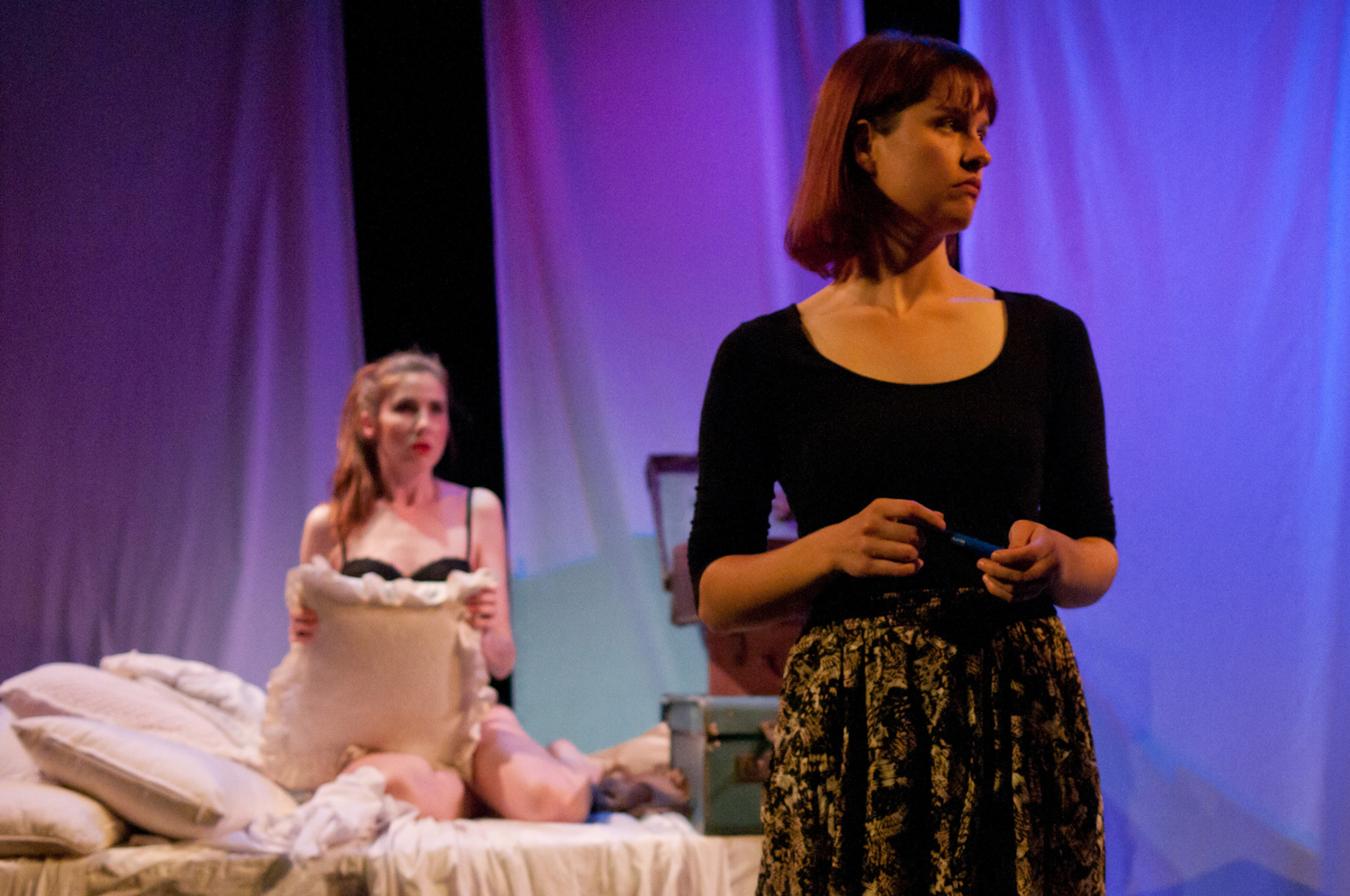
The show is a web of seductive tales woven around two competitive writers, Ana (Kathryn Delaney) and Henry (Lawrence Ashford). The two friends set each other a new writing challenge: sensual fiction. Each writer must attempt to write erotica. Henry accuses Ana of being uptight, and Ana tells Henry that sex isn’t all about penetration. They each struggle to take on the challenge, facing up to their personal taboos and secret fantasies. Centred in their sensual scenes is the waitress from their coffee shop, played by Zoe Cooper. The writers craft their characters in her image, and she becomes goddess, whore, dominatrix, whatever they need her to be.

Flirt Fiction production still, courtesy Angela H King
Zoe Cooper and Kathryn Delaney flirt with fiction.

Flirt Fiction is an interesting exploration of erotica, and how we craft our fantasies. With a strong script by Jessica Craig-Piper, the show explores the vulgar and the obvious in erotica, then goes deeper, reflecting on how our identities inform our consumption of sex. Woven through the story is a sweet thread of romance, which elevates the play from a collection of vulgar sketches and creates an engaging narrative.

Ashford is the stand-out performer of the show; he had the audience from his opening monologue and held them right through the play. Delaney, too, gave a strong performance and played her character with an admirable mix of strength and vulnerability. Cooper was perhaps the least engaging; although she gave a brave performance as the muse who is stripped of her clothes and bent into any position the others wish, she was somehow too brittle, and not terribly convincing as a flirt.

On the night this reviewer watched the play, it was unfortunate that the audience was not terribly responsive. There were a few murmurs of laughs at some of the naughty jokes, but mostly just the tense silence of an uncomfortable audience. While Ashford’s comic timing was spot-on, Delaney and Cooper missed a few chances for laughs, so that the energy fell flat. Unfortunately, the biggest laugh came in the middle of a heartfelt monologue about bestiality and rape, which was clearly intended to be an emotional peak in the story. Instead, the audience was left chuckling and hoping for relief from the confronting sound effects. The play’s finale was undercut by The Blue Room Studio’s black box set-up, which means that the actors freeze in their final position, then immediately unfreeze and wave goodbye to the audience. Awkward.

Despite some setbacks, this show is enjoyable and intensely interesting. Although not, perhaps, for the faint-hearted. At the end of the show, a man loudly said to his friend ‘I did NOT like that’, and two young women from the front row were evidently most concerned that they were going to be hit in the face by a strap-on dildo. It seems the show did not ‘find its audience’ that night. But if you can get past the graphic sexuality and the desire to giggle like a schoolgirl, then you’ll find Flirt Fiction a rewarding experience.

Flirt Fiction is showing at The Blue Room until Saturday 22 October.

Read this review and heaps of other up-to-the-minute info about Australian theatre on TheatrePeople.com.au


I’ve uploaded another video from my Voicebox gig back in July. It’s a short hip hop-style poem I wrote called ‘Think About What You’re Saying’, decrying the misuse of language. At the beginning of the vid, I’m having a little chat with the audience. They were great that night; I even had a couple of hecklers. I was telling the crowd that I’ve been writing poetry for 20 years, and some wag called out “How old are you?” Whoever that was, thank you for participating in the banter. I very much enjoyed it.


Posts

Cafe Poet Update: CHALK LINES

Posts

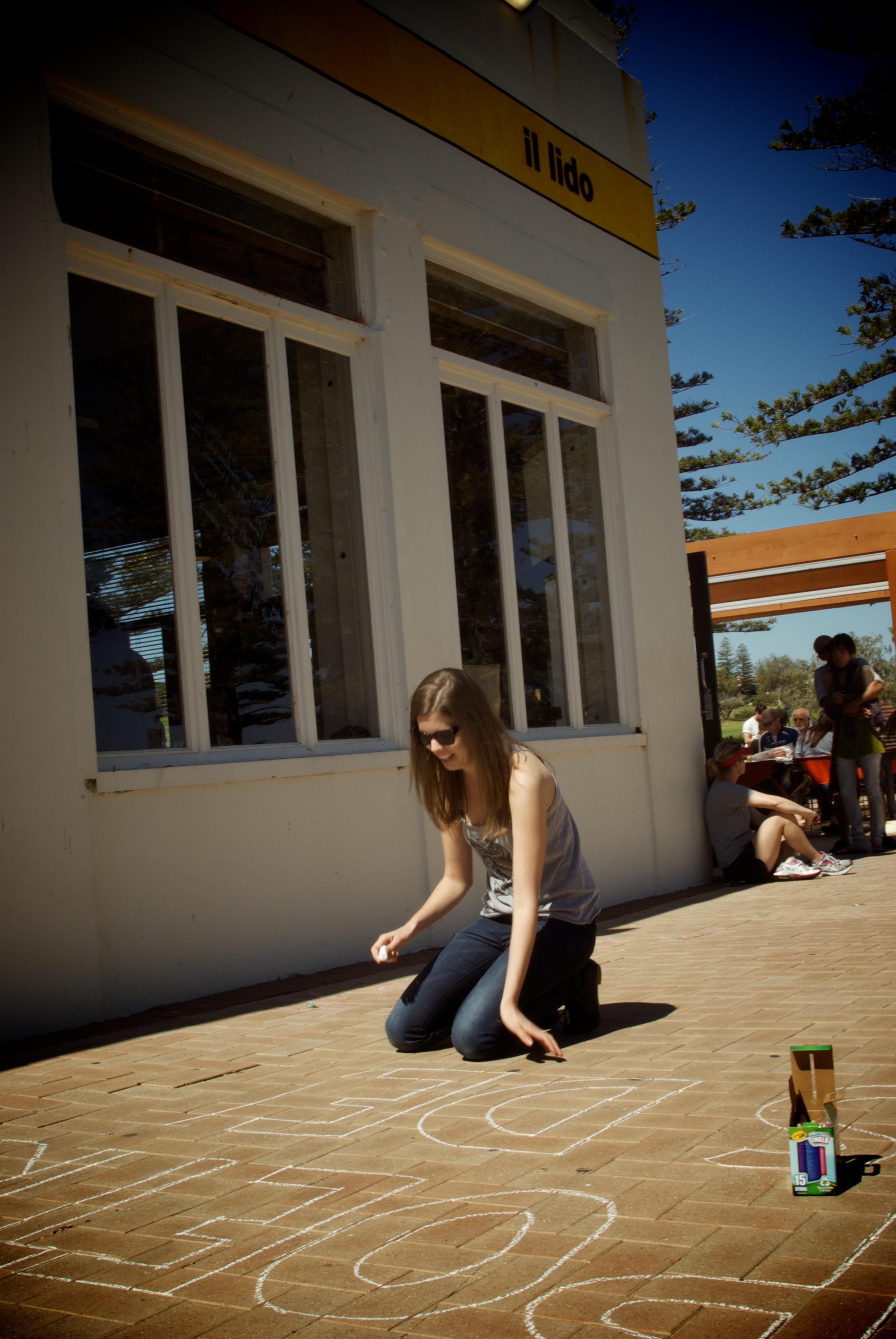
Last weekend’s inaugural CHALK LINES was a modest success, with the (mainly baffled) patrons of Il Lido watching poetry in motion while they ate their lunch.

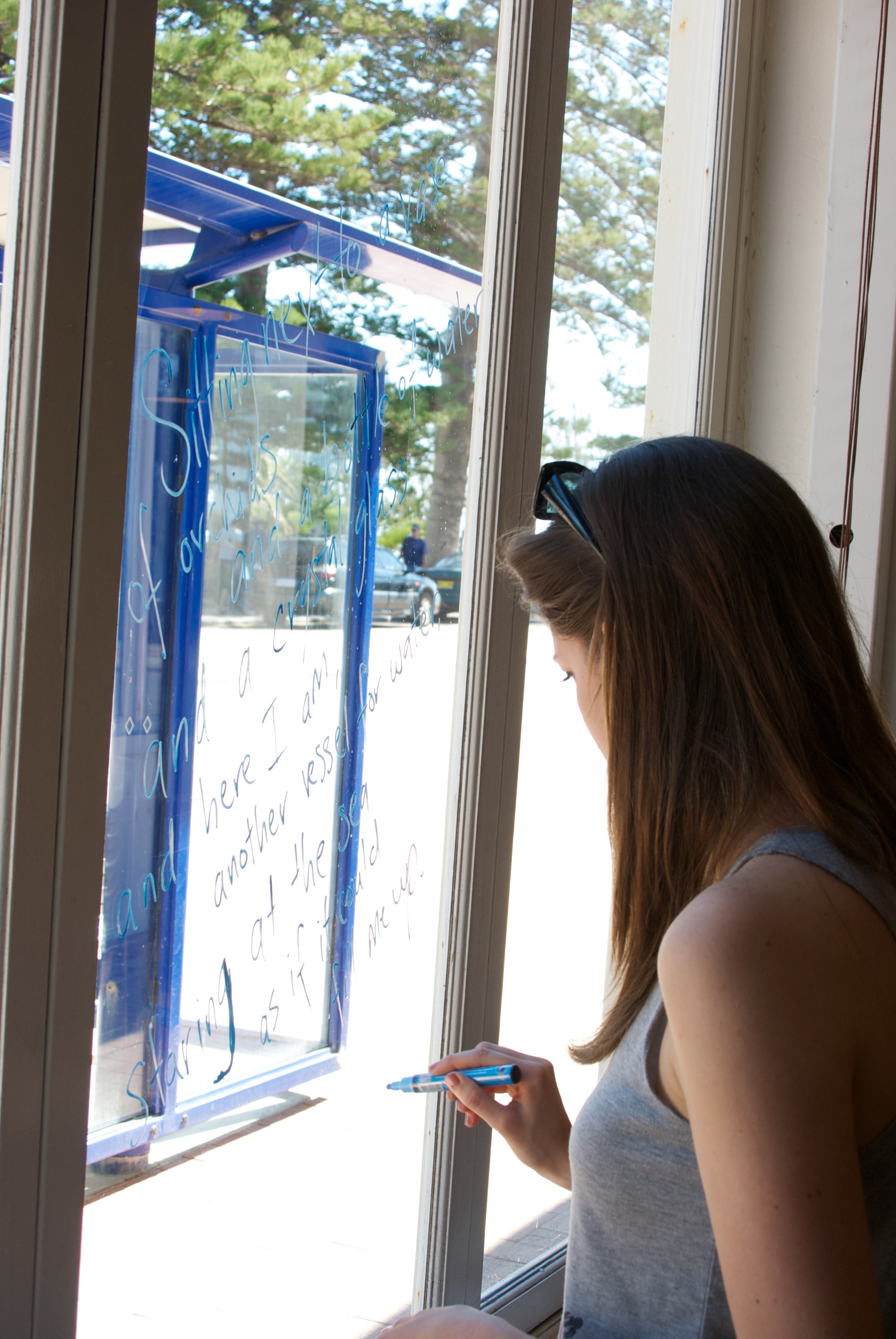
The event was in celebration of National Poetry Week. I wrote my own original poetry on different surfaces all over the restaurant and the footpath outside. I wondered if I might find out first-hand what the local laws about street art are, but the po-po never made an appearance. One Cottesloe resident did tell me he would put me under citizen’s arrest for vandalism, but he was quickly appeased when I included his dog Daisy in the poetry-art.

Penning a poem on a window.

I spent the perfect spring weather scribbling all over the restaurant with chalk pens and sidewalk chalk, and dropping cards of poetry on the tables. Most popular was the poem ‘What Is She’ scrawled across the white tiled walls of the ladies’ toilets. Everyone likes something to read in the bathroom, after all.

It was gratifying to have people approach me and start passionate conversations about poetry. One kind gent even bought me lunch to “support the arts”. ART DOES PAY! He drove past later and recited a poem out the window of his car. What a champ. I also had the joy of watching a couple walk along the footpath reading a line from one of my poems to each other.

The staff were equally supportive, encouraging me to write on the windows and passing along feedback from customers. Il Lido is fast becoming one of my favourite spots in Perth, and not just because of its support of poetry; the view is unchangingly gorgeous, the food is mouthwatering, and the whole establishment has a fine appreciation for its place within the community and Cottesloe’s history. It has a very comfortable atmosphere.

Chalking away on Marine Parade.

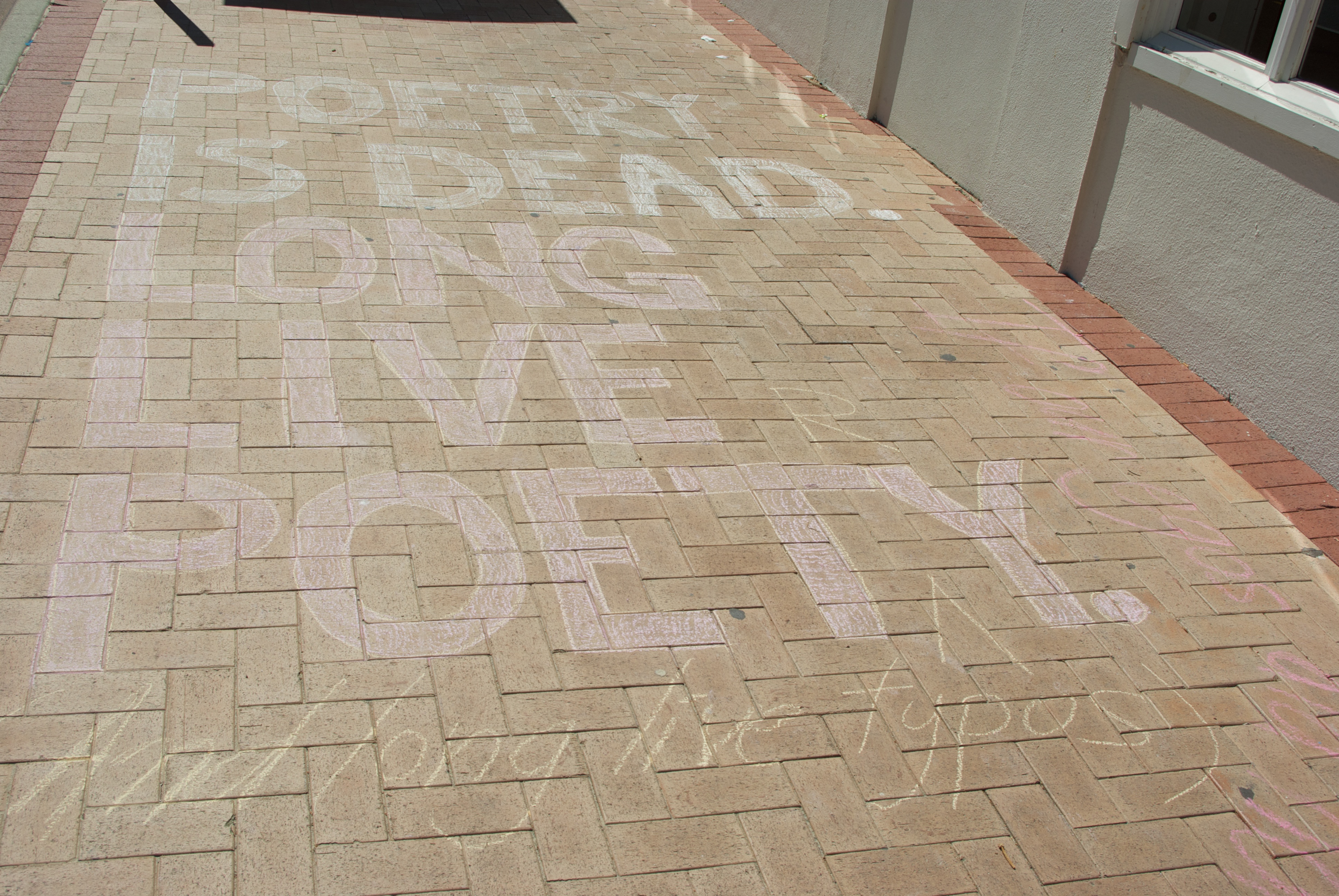
The only black spot in my sunshiny weekend was the fact that I misspelled “poetry” in one of my chalkings. Luckily there were plenty of eagle-eyed passers-by keen to notify me. What helpful souls.

LONG LIVE POETRY.

POETRY IS DEAD. LONG LIVE POET(R)Y. (And long live typos.)

Waxings interview: “On poetry, writer’s block and eating”, Sept 2011

Posts

Since the unfortunate decimation of the National Young Writers’ Month blog, my interview with poet/filmmaker David Vincent Smith disappeared with the rest of the NYWM blog posts. But ALL IS NOT LOST because the article has been republished on Waxings.

I’ve just sat down for a chat with Perth writer and filmmaker David Vincent Smith, also known as DVS (pronounced ‘Devious’ – see what he did there?). DVS is one of Perth’s best performance poets, as well as one of the founders of Seventh Continent Productions. And he’s twenty-three years old. When he saunters in with his scruffy beard and wide grin, you might mistake him for a bad Gen Y stereotype – but this is one of the hardest working young writers in Perth.

“I’m a firm believer that writer’s block doesn’t exist,” he says. “I think it’s just an excuse. The idea that you could sit down and not be able to write is a load of shit. Writer’s block is not being able to write up to the standard that you want to be writing at that moment. I mean, nobody can always write their best piece every day. So, you just sit down and start writing and eventually, after maybe a page or two, you get into the flow. You get one line that will trigger an entire new thought and bang, you’re away. So, whenever people say, ‘Aw, yeah I’ve got writer’s block, I haven’t really done much in six months,’ I’m like, bullshit, you haven’t got writer’s block – you bought Call of Duty. Sit down over there, start writing.”

It might sound a bit severe, but this writer expects nothing less from himself. “I was working in a supermarket from when I was fourteen to nineteen, and I used to get fifteen-minute lunchbreaks. Because it was such mundane work, the whole time I was working I’d memorise paragraphs of the book I was working on, then write them out in my lunchbreaks. At night I’d go home and just compile it together. I was like, don’t waste a minute of your time, always be writing. Now I’m really brutal on myself – I just work, work, work.”

And all this effort has been paying off for the writer/director. In 2010, DVS was flown back and forth between Perth and Sydney, for free, twice. The first trip was to attend the finals of the Optus One80Project with his co-director Aaron Moss, where their film Southern Cross won the Viewers’ Choice Award. The Award came with a $10,000 cash prize, which the guys re-invested in their production company Seventh Continent. They also got to chat with Australian film industry success stories like Blue-Tongue Films (Animal Kingdom) and David Wenham (The Return of the King, Oranges and Sunshine).

DVS’s second trip to Sydney last year was for the national finals of the Australian Poetry Slam. He entered the 2010 WA Poetry Slam and quickly won his way to the state finals with a hip hop poem entitled ‘Fortified’. With lines like ‘My father gave me a shovel at twelve/ And I’ve been burying my emotions ever since,’ he won over the crowd and took out first place, snagging himself a place in the finals held at the Sydney Theatre Company.

Since then, he’s barely sat still. Earlier this year, he and Aaron produced a short film about slam poetry, called The Ballad of Nick Chopper, for which DVS wrote the script and most of the poetry. The film screened at the Perth Poetry Slam finals in February. They also entered another film in the 2011 Optus One80Project, Family Tree, as well as working on several other projects, including two new feature films and several music videos. Even as we speak, DVS reminds me that he can’t stay long because he has to get another script finished by today. Phew, this dude never stops!

“I usually have so many different projects on the go. I’m usually either writing for film, writing for music, or writing for spoken word. Or some article that I feel like writing just for the hell of it. If I want to take a break I just switch what I’m doing. Like, okay I’ve had enough of poetry, I’ll do film writing tomorrow. But I usually have so many different deadlines.

“Deadlines are really good, because they kind of force you to be creative. You could be like, well, my life goal is to write a novel. Well you could start that when you’re fifty, you know. One of my first life goals was ‘you must write a novel before you’re twenty-one’ and I ticked that off my list, and now my next goal is ‘you must make a feature film before you’re twenty-five’ and I’m really stressing out about that one! Unless someone gives me millions of dollars after reading this interview…” (NB: Cheques are payable to David Vincent Smith.)

DVS and I get to chatting about life in the creative arts. Like most young, arty-type people, we almost immediately began with ‘OMG how broke are we?’ While our friends with Law and Economics degrees are slaving away with the (possibly incorrect) assurance that they’re guaranteed a well-paid job one day, we of the Arts have not even that comfortable illusion. Sometimes following your passion means giving up financial security. DVS lives by himself and pays his own way, so I ask him how he’s been supporting himself while he makes his career in writing and film. He does some casual shifts at a bar in Northbridge, but I find out most of his money comes from an unusual source.

“I’ve gotten by for fourteen or fifteen months now just by winning random competitions and pawning off the prizes. Last year Aaron and I each won a Blackberry [for Southern Cross], and I sold mine to a chef in the kitchen next door at work. I hell needed money that week; I needed to go grocery shopping, haha.”

I ask him if he thinks we’re right to be encouraging kids to pursue writing when it’s such a poorly paid career path. Would it be wiser to caution them to get ‘real jobs’ to fall back on, rather than risk being a starving artist?

“I think you can only say what you did, and then let them make their decision,” DVS reasons. He knew from the age of eight or nine that he wanted to be a writer, and no threats of financial insolvency could hold him back. After high school, he enrolled in an Information Management course at Curtin University, but it didn’t interest him. “To be honest, I don’t even remember it. Uni was something that happened between what I wanted to do with my life, so it’s all a blur. If I didn’t find the odd assignment in my drawers every now and then, I’d forget I even went.”

Instead, he switched to TAFE (now called the Central Institute of Technology) and completed an Advanced Diploma of Screen (Directing). “I knew what I wanted to do and what I wanted to be in terms of film studies, so I asked my lecturers lots of questions and really tried to get out what I wanted.”

Does he regret choosing the uncertain path of an arts career over a steady job in Information Management?

“I definitely thought about going the safe way, and then I thought, stuff it. Obviously it makes sense to have something to fall back on – it just depends how much you care about security. I like the idea of being able to eat food, but my aim in life is not to have a mansion or drive around in a Mercedes-Benz. My aim is to be able to spend every day writing and growing as an artist. I mean, that sounds really pretentious, but [that lifestyle] is more enjoyable, to be honest.”

I point out that, for most committed artists, their aspirations don’t reach as high as mansions or flash cars – they’re just aspiring to eat well and pay rent. A lot of young artists can’t afford to move out of home. David nods. “I do live out of home, but I’d love to be able to live out of home. And not slowly die out of home,” he laughs.

Having seen DVS in action on stage, I’m curious to know what goes through his mind while he’s performing his poetry. He laughs, and explains, “I was about to say, ‘not a lot’. I guess I’m very conscious of trying to engage people. Also, my hands – I see the words as movements. It’s hard to explain, but I see it as connections. I usually try to break each line down into an actual hand movement.”

I remember this from watching his performances – he almost seemed to have choreographed his poetry.

“When I’m writing I’m already seeing the hand movements,” he says. “I usually don’t sit down when I write, I usually walk around in circles. It’s like I’m orchestrating what I’m writing. It’s kind of a strange thing. So if you ever see me writing I’m just walking around in circles waving my hands in the air. It looks like I’m trying to do swimming freestyle through the air. And then [the movements] slowly become more controlled and constructed.

“I guess the other thing that’s kind of weird is sometimes before I start writing I know I kind of want to write a piece about [a certain idea], but I’m not really sure what it’s going to be about. So I kind of just let all the words that have to do with that kind of idea just bubble in my mind, and I just keep thinking of words that have to do with that. And then like you kind of get a – it’s hard to explain – like a taste in your mouth, and then you just go after a while.

“Sometimes if you have a good idea, rather than just starting to write it, you just let it simmer in your mind for a few weeks, and you let it build and build until you feel the story in your body, and then after a few weeks it just happens.”

Like they (whoever they are) say, writing is one per cent inspiration and ninety-nine per cent perspiration. David Vincent Smith is a writer who seems to understand the importance of both.