Limerick for my 200th tweep

Posts

Today I reached 200 followers on Twitter, with a Mr Gavin Heaton (@servantofchaos) being #200! As a token of thanks to him, I offered to compose a celebratory limerick.


Well Gavin, I am a poet of my word. (As are all poets, really – I mean, that’s all we have, just words … Anyway.) Here is your limerick, and please remember that I never promised it would be good.

There once was a tweep named Gavin.
A lot of Klout he be havin’.
So I wouldn’t be sundered,
helped me to two hundred
followers. Now I be laughin’.

Many thanks to everyone who’s followed me on Twitter or via one of my blogs (if you haven’t seen my new micro-story blog yet, check out Transports of Delight). I promise to write a limerick for my 300th Twitter follower, too! Or, depending on the popular response, I could promise to never publish another lame limerick ever again. Up to you guys.


Inua Ellams: ‘Musical and delicious to the ear’, March 2012

Posts

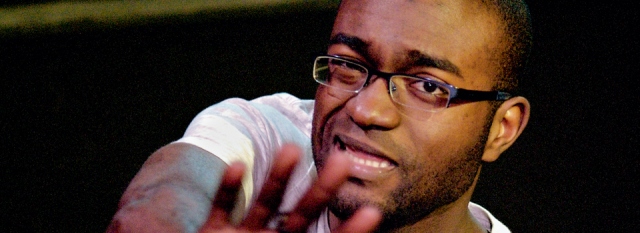
As part of Waxings blog’s coverage of the Perth Writers’ Festival, I had the opportunity to interview poet Inua Ellams. Here is the feature, as published on Waxings.org, March 2012.

Performance poetry is gradually finding its way out of the grunge-covered back rooms of dark pubs and catching the attention of wider audiences. One of the poets carrying this contemporary artform into the mainstream is Inua Ellams, a Nigerian-born Londoner who recently travelled to Australia to feature at the Perth Writers Festival.

Ellams was invited to the PWF to perform his play The 14th Tale, a one-man show combining poetry, performance, and personal narrative.

I ask Ellams if he had done any theatre before The 14th Tale. “The 14th Tale was my first theatric outing. My first collection of poems was published in about 2009 and I tried to stage the poems with a little bit of banter in between, but it didn’t quite work. There wasn’t a strong narrative, so I scrapped that and wrote The 14th Tale.”

Ellams’ poem-play is autobiographical, following the foibles of his mischievious childhood in Africa, weaving in tales of the men in his family. Ellams describes himself as a born trouble-maker, although he tells me over the phone (and you can actually hear the twinkle in his eye) that now he is making a different kind of trouble.

“Poetry for me walks the line between lyrics and finely, tightly written prose. I think that’s how I try to cause trouble – well, regarding work specifically, that’s how I try to cause trouble. By being aware of the line and walking it and constantly trying to redefine it. That’s one of the ways I cause trouble.”

Walking that line often means not fitting neatly into any one genre. Ellams is an accomplished poet of both the page and the stage but he still feels that he is not quite accepted by either.

“In London, I am often described as a performance poet, sometimes as a spoken word poet, sometimes as a page poet …” Ellams muses. “And sometimes I find that I am marginalised by both groups. There is this line that I seem to walk. And I continually try to further blur the lines, and even at performance poetry sets I just read my page poems. And when I write page poems, I just make them sound as musical and delicious to the ear as songs do.”

Speaking of delicious to the ear – Ellams’s voice is like a song itself. Soft and lyrical. Even when he talks casually, he sounds as if he is riffing on ideas for a new poem. And I think that is exactly the effect this poet is going for. Ellams speaks about poetry with a self-conscious pride, confident in his abilities as a wordsmith. He lacks the self-deprecatory humour that I personally can’t seem to shake off whenever I tell people I write poetry. For Ellams, poetry is not an indulgent activity. It is his craft. And it has held his life together.

Ellams tells me about a close friend of his from Dublin, Stephen Devine. They went to school together as teenagers, and the two boys had a friendship built on a love of language. “He and I would sit down and argue about the colour of the sky. We would just sit there for hours.” Then one summer, Ellams received a phone call telling him that Devine had been found dead, hanging from a beam in his garage. “I guess my world became very destabilised and the part of me that excelled with language, with Stephen, was no longer there. And I started writing to keep that part of myself alive, really.”

Since Ellams often performs his poetry, I enquire as to whether he takes the audience into consideration when writing. A debate that keeps coming up within the performance poetry community is whether a poet compromises their artistic integrity by writing to entertain the audience. Purists say one should perform for their own pleasure only; at the other extreme, entertainers seek only to win over the crowd. Ellams’s philosophy is an elegant compromise. “I always write for myself, of things that complicate me on a personal level. And then I edit it knowing that other people will have to come to this.”
So what does Ellams think of slam poetry, where poets are pitted against each other with only two minutes to please the judges? He hesitates. “I like it and dislike it in an equal sense.”

Ellams illustrates his opinion of slam poetry by telling me the story of a slam where he performed a poem that scored high – “it was the best poem of the night” – but ultimately did not win. “This guy, this huge guy stood up and read this poem about accidentally drinking urine which he found in a bottle of gin. And he got a full 30 points for that.” Ellams laughs incredulously. “I thought, this is never happening to me again.” He hasn’t slammed again since.

Whatever his personal feelings, Ellams is charitable as to the role of slam poetry in our culture. “I do think [slam poetry] has done a lot for the appreciation of poetry. Especially in the West, where we do have this competitive environment which champions oneupmanship and the idea of the individual. So, bringing poetry – which is old and classic and sometimes viewed as a dead past-time – bringing that into the twenty-first century I think has been really afforded and helped greatly by slams.”

Since first performing The 14th Tale in 2009, this already-established poet has written two successive solo shows, the most recent of which is currently touring Britain. Inua Ellams is a rising star of the spoken word scene. There is something about the frankness with which he describes himself and his work that borders on arrogance; there’s a lack of humility. But, as I talk to this charismatic young man, I can’t think of him as arrogant. He is simply focused. Poetry is a very serious craft in which he works hard to achieve a high standard. The Romantics would be nodding in approval. And the fact that Ellams is also crossing mediums to bring poetry to more people – that is just gravy.

Three Strikes (Source: The Blue Room)

“Three Strikes could only happen in LA”, Feb 2012

Posts

A review I wrote for Perth Now‘s coverage of Fringe World, as part of the Buzzcuts Perth program. Published in February 2012 on PerthNow.com.au.

Has Jay Leno ever handed you a steak sandwich? Well, it happened to Brian Finkelstein.

Three Strikes is the true story of ridiculous events from Brian’s life, focusing around the American Writers’ Strike of 2007. At the time of his third strike, Brian was a comedy writer for The Ellen DeGeneres Show in Los Angeles. He found himself walking in circles holding a picket sign for reasons he barely understood.

Three Strikes (Source: The Blue Room)

Brian’s style of delivering his story is at once coarse and endearing. You can’t help liking the guy. You might feel that maybe you shouldn’t like this guy, since he starts off the show by telling the audience to shove their mobile phones where the sun don’t shine. In the beginning, he paints himself as an apathetic slacker with no beliefs or values. However, as the story progresses, Brian teases out more of his past, and reveals key events that brought him to that writers’ picket line in LA. His growing disillusionment with the world has a universal ring to it.

It is a fascinating story, and not just because he met Jay Leno. Brian compares the American Writers’ Strike of 2007 to the Haymarket Massacre of 1886 (an anarchist violent protest over working hours), and he does so with piercingly funny wit.

This one-man show boasts a cleverly written script (by Brian himself), hilarious characterisations, and powerful use of the stage space. With a running time of 50 minutes, the story never overstays its welcome, and it is a brilliant addition to any night out.

The show takes place in the PICA performance space, which is perfectly located in the beautifully decorated cultural centre. Afterwards, you can wander up to the Urban Orchard to discuss Brian’s story over a beer.

Three Strikes finishes this Saturday, so be sure to book your tickets before this master of storytelling jets back to LA. This might be your last chance to see him perform – who knows when he’ll go on strike again?

“Barry Morgan shows off his organ”, Feb 2012

Posts

A review I wrote for Buzzcuts and Perth Now of the Fringe World show, Barry Morgan’s World of Organs. After the show, I had the pleasure of meeting Barry himself. Such a grin!

Barry Morgan and I

You might know Barry Morgan, Adelaide’s celebrity organ salesman, from his appearances on the music quiz show Spicks and Specks.

Barry’s trademark toothy grin and his prodigious skill on the keyboard were all he needed to win over television audiences. So, when it was announced that Barry Morgan would be coming to Fringe World, I was curious to see how he would flesh out his camp keyboard act into a one-hour show.

Barry Morgan’s World of Organs is a mildly strange experience from the moment you walk into the Perth Town Hall. Underneath the grand proscenium arch sits a 1981 Hammond Aurora Classic with matching Leslie speakers, looking very small indeed in contrast with the pomp of the venue. A badly recorded voice comes over the speakers, announcing the star of the show. Then out walks Mr Barry Morgan himself, all smiles and big hair.

The organ salesman immediately launches into his hilariously camp patter, announcing “this organ must be sold tonight!” The rest of the show is an extended sales pitch, with Barry avidly trying to convince audience members of the wonders of the electric organ.

Barry works the crowd with delightful ease, throwing out organ innuendos that never seem to get old. On this night, the audience seemed at first uncertain, but quickly got into the spirit of things with sing-alongs and shout-outs.

Although Barry’s talent on the organ is the central spectacle, the show has a great audio-visual element. A screen hangs over the stage onto which Barry projects photos from his childhood and footage from the stage.

Aside from a very strange moment when Barry abruptly disappears from the stage to “change into something more comfortable” and then returns wearing an almost-identical outfit, the show runs along smoothly.

Happily, this is a Fringe show that is suitable for all audiences. It’s a fun, light-hearted hour of comedy that will be especially pleasing for music-lovers.

The winner of Bogan Bingo and his be-mulleted mates

Perth Now entertainment review: “Flannel fun at Bogan Bingo”, Feb 2012

Posts

A review I wrote for Buzzcuts and Perth Now, of the Fringe World show Bogan Bingo.

Bogan Bingo is, quite simply, a bingo night run by bogans.

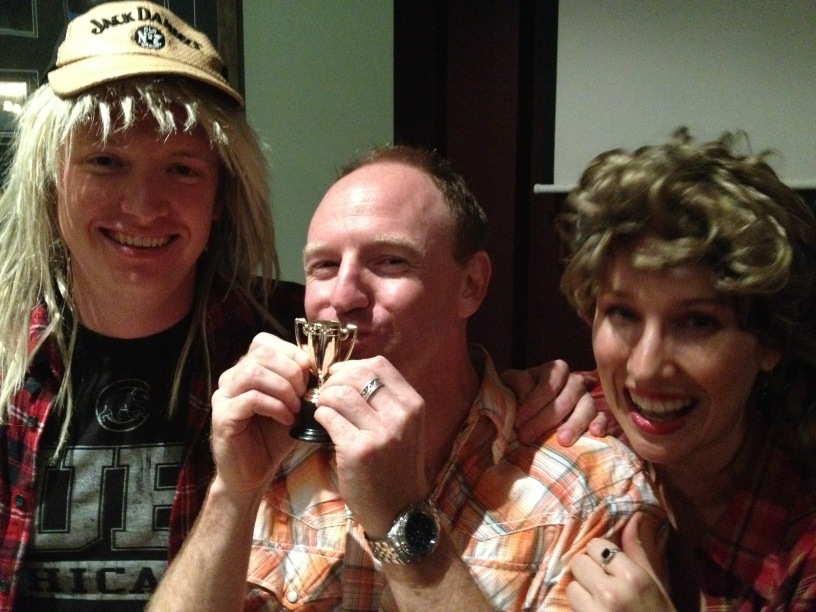
The winner of Bogan Bingo and his be-mulleted mates

If you’ve ever thought that bingo nights don’t include enough AC/DC and swearing, then you might want to get down to Rosie O’Grady’s during Fringe. Just make sure to check your political correctness at the door, because these bogans aim to offend.

The flannel-clad comedians running this night had the audience cringing at off-colour jokes about pedophilia, bestiality, and Steve Irwin’s death. (‘That’s low,’ groaned one audience member.) However, Bogan Bingo’s humour is so self-conscious that they just get away with it. Just.

The drawing of each bingo number is punctuated by a rock ‘n’ roll hit from the ’80s. There’s sing-alongs, mullet wigs, and an Air Guitar Championship. The crowd can get a bit lively – this reviewer was nearly knocked over by a woman charging at the stage to win an inflatable guitar.

The night only runs for one round of bingo, which can be a relief for the audience, as the host’s ball-related innuendos get old fast. The show’s energy levels stay up during their short running time, except for an awkward three minutes where they try to make everyone stand up and sing Khe Sanh. The whole song. All of it.

Still, this is a fun night out. If you’ve got a bunch of friends who aren’t easily offended, then this might be the bingo night for you.

I’ll be on Radio Fremantle 107.9fm from 10.30am this morning, reading some of my poetry and having a bit of a chat. Tune in if you’re in the area!

In other news, the Buzzcuts Perth program has been going well! The crack team of writers I’m coordinating have been writing up some fantastic reviews of Fringe World. You can read them on the Buzzcuts blog, or on PerthNow.com.au

Speaking of Fringe World, if you’re in Perth you should definitely be checking out some Fringe shows! There’s 150 shows on offer, with heaps of variety. I especially recommend the story showcase Barefaced Stories at the Blue Room. I might be a bit biased because I’m one of their storytellers (I did the Barefaced opening night on Tues) but seriously it’s a brilliant show! And it’s different every show, so you can go to more than one.

So much to do! Huzzah!

Posts

With the support of Express Media, Fringe World, and the Sunday Times, I am very pleased to introduce BUZZCUTS PERTH!

Buzzcuts is a program that trains young writers and broadcasters in critical arts reviewing. After running successfully in Melbourne for 15 years, this year the program is expanding to include Perth, with the support of Express Media, Fringe World, and the Sunday Times.

Buzzcuts Perth gives successful applicants the chance to see several Fringe World shows for free, write reviews and see them published on the Perth Now website. Participants will also be trained in writing critical arts reviews at a free orientation session.

The program is open to writers aged 18-25 who live in the Perth area and are interested in developing their skills as entertainment/arts writers.

Participants are expected to attend at least two shows during Perth’s Fringe World festival (26 January – 19 February) and to produce two accompanying reviews. In addition, participants are required to attend the compulsory orientation to be held in mid-January (date to be confirmed).

To apply, please submit the following:

  1. Your contact information (name, street address, email address, phone number, and date of birth)
  2. A cover letter outlining why you would like to be involved and any experience you have relevant to the area (experience in arts reviewing is preferable but not essential)

Send applications to:

Kaitlyn Plyley

kaitlynplyley@gmail.com

Applications close: 5pm, Sunday 14th of January 2012.

Successful applicants will be contacted via email.

Posts