Waxings interview: “On poetry, writer’s block and eating”, Sept 2011

Posts

Since the unfortunate decimation of the National Young Writers’ Month blog, my interview with poet/filmmaker David Vincent Smith disappeared with the rest of the NYWM blog posts. But ALL IS NOT LOST because the article has been republished on Waxings.

I’ve just sat down for a chat with Perth writer and filmmaker David Vincent Smith, also known as DVS (pronounced ‘Devious’ – see what he did there?). DVS is one of Perth’s best performance poets, as well as one of the founders of Seventh Continent Productions. And he’s twenty-three years old. When he saunters in with his scruffy beard and wide grin, you might mistake him for a bad Gen Y stereotype – but this is one of the hardest working young writers in Perth.

“I’m a firm believer that writer’s block doesn’t exist,” he says. “I think it’s just an excuse. The idea that you could sit down and not be able to write is a load of shit. Writer’s block is not being able to write up to the standard that you want to be writing at that moment. I mean, nobody can always write their best piece every day. So, you just sit down and start writing and eventually, after maybe a page or two, you get into the flow. You get one line that will trigger an entire new thought and bang, you’re away. So, whenever people say, ‘Aw, yeah I’ve got writer’s block, I haven’t really done much in six months,’ I’m like, bullshit, you haven’t got writer’s block – you bought Call of Duty. Sit down over there, start writing.”

It might sound a bit severe, but this writer expects nothing less from himself. “I was working in a supermarket from when I was fourteen to nineteen, and I used to get fifteen-minute lunchbreaks. Because it was such mundane work, the whole time I was working I’d memorise paragraphs of the book I was working on, then write them out in my lunchbreaks. At night I’d go home and just compile it together. I was like, don’t waste a minute of your time, always be writing. Now I’m really brutal on myself – I just work, work, work.”

And all this effort has been paying off for the writer/director. In 2010, DVS was flown back and forth between Perth and Sydney, for free, twice. The first trip was to attend the finals of the Optus One80Project with his co-director Aaron Moss, where their film Southern Cross won the Viewers’ Choice Award. The Award came with a $10,000 cash prize, which the guys re-invested in their production company Seventh Continent. They also got to chat with Australian film industry success stories like Blue-Tongue Films (Animal Kingdom) and David Wenham (The Return of the King, Oranges and Sunshine).

DVS’s second trip to Sydney last year was for the national finals of the Australian Poetry Slam. He entered the 2010 WA Poetry Slam and quickly won his way to the state finals with a hip hop poem entitled ‘Fortified’. With lines like ‘My father gave me a shovel at twelve/ And I’ve been burying my emotions ever since,’ he won over the crowd and took out first place, snagging himself a place in the finals held at the Sydney Theatre Company.

Since then, he’s barely sat still. Earlier this year, he and Aaron produced a short film about slam poetry, called The Ballad of Nick Chopper, for which DVS wrote the script and most of the poetry. The film screened at the Perth Poetry Slam finals in February. They also entered another film in the 2011 Optus One80Project, Family Tree, as well as working on several other projects, including two new feature films and several music videos. Even as we speak, DVS reminds me that he can’t stay long because he has to get another script finished by today. Phew, this dude never stops!

“I usually have so many different projects on the go. I’m usually either writing for film, writing for music, or writing for spoken word. Or some article that I feel like writing just for the hell of it. If I want to take a break I just switch what I’m doing. Like, okay I’ve had enough of poetry, I’ll do film writing tomorrow. But I usually have so many different deadlines.

“Deadlines are really good, because they kind of force you to be creative. You could be like, well, my life goal is to write a novel. Well you could start that when you’re fifty, you know. One of my first life goals was ‘you must write a novel before you’re twenty-one’ and I ticked that off my list, and now my next goal is ‘you must make a feature film before you’re twenty-five’ and I’m really stressing out about that one! Unless someone gives me millions of dollars after reading this interview…” (NB: Cheques are payable to David Vincent Smith.)

DVS and I get to chatting about life in the creative arts. Like most young, arty-type people, we almost immediately began with ‘OMG how broke are we?’ While our friends with Law and Economics degrees are slaving away with the (possibly incorrect) assurance that they’re guaranteed a well-paid job one day, we of the Arts have not even that comfortable illusion. Sometimes following your passion means giving up financial security. DVS lives by himself and pays his own way, so I ask him how he’s been supporting himself while he makes his career in writing and film. He does some casual shifts at a bar in Northbridge, but I find out most of his money comes from an unusual source.

“I’ve gotten by for fourteen or fifteen months now just by winning random competitions and pawning off the prizes. Last year Aaron and I each won a Blackberry [for Southern Cross], and I sold mine to a chef in the kitchen next door at work. I hell needed money that week; I needed to go grocery shopping, haha.”

I ask him if he thinks we’re right to be encouraging kids to pursue writing when it’s such a poorly paid career path. Would it be wiser to caution them to get ‘real jobs’ to fall back on, rather than risk being a starving artist?

“I think you can only say what you did, and then let them make their decision,” DVS reasons. He knew from the age of eight or nine that he wanted to be a writer, and no threats of financial insolvency could hold him back. After high school, he enrolled in an Information Management course at Curtin University, but it didn’t interest him. “To be honest, I don’t even remember it. Uni was something that happened between what I wanted to do with my life, so it’s all a blur. If I didn’t find the odd assignment in my drawers every now and then, I’d forget I even went.”

Instead, he switched to TAFE (now called the Central Institute of Technology) and completed an Advanced Diploma of Screen (Directing). “I knew what I wanted to do and what I wanted to be in terms of film studies, so I asked my lecturers lots of questions and really tried to get out what I wanted.”

Does he regret choosing the uncertain path of an arts career over a steady job in Information Management?

“I definitely thought about going the safe way, and then I thought, stuff it. Obviously it makes sense to have something to fall back on – it just depends how much you care about security. I like the idea of being able to eat food, but my aim in life is not to have a mansion or drive around in a Mercedes-Benz. My aim is to be able to spend every day writing and growing as an artist. I mean, that sounds really pretentious, but [that lifestyle] is more enjoyable, to be honest.”

I point out that, for most committed artists, their aspirations don’t reach as high as mansions or flash cars – they’re just aspiring to eat well and pay rent. A lot of young artists can’t afford to move out of home. David nods. “I do live out of home, but I’d love to be able to live out of home. And not slowly die out of home,” he laughs.

Having seen DVS in action on stage, I’m curious to know what goes through his mind while he’s performing his poetry. He laughs, and explains, “I was about to say, ‘not a lot’. I guess I’m very conscious of trying to engage people. Also, my hands – I see the words as movements. It’s hard to explain, but I see it as connections. I usually try to break each line down into an actual hand movement.”

I remember this from watching his performances – he almost seemed to have choreographed his poetry.

“When I’m writing I’m already seeing the hand movements,” he says. “I usually don’t sit down when I write, I usually walk around in circles. It’s like I’m orchestrating what I’m writing. It’s kind of a strange thing. So if you ever see me writing I’m just walking around in circles waving my hands in the air. It looks like I’m trying to do swimming freestyle through the air. And then [the movements] slowly become more controlled and constructed.

“I guess the other thing that’s kind of weird is sometimes before I start writing I know I kind of want to write a piece about [a certain idea], but I’m not really sure what it’s going to be about. So I kind of just let all the words that have to do with that kind of idea just bubble in my mind, and I just keep thinking of words that have to do with that. And then like you kind of get a – it’s hard to explain – like a taste in your mouth, and then you just go after a while.

“Sometimes if you have a good idea, rather than just starting to write it, you just let it simmer in your mind for a few weeks, and you let it build and build until you feel the story in your body, and then after a few weeks it just happens.”

Like they (whoever they are) say, writing is one per cent inspiration and ninety-nine per cent perspiration. David Vincent Smith is a writer who seems to understand the importance of both.
Theatre People review: “The Yellow Wallpaper”, Sept 2011

Posts

This is a review I wrote for Theatre People of a theatrical adaptation of the famous short story, ‘The Yellow Wallpaper’.

The Yellow Wallpaper is a new Perth production based on Charlotte Perkins Gilman’s gothic short story of the same name, adapted for stage by Silvia Lehmann and Teresa Izzard. This beautiful play gives a twisted physicality to the tale of a woman, Charlotte, who is struggling to cope after the birth of her first child. Her husband, a doctor, prescribes a ‘rest cure’ – a popular remedy for ‘hysterical tendencies’ in 1892. Stuck in the upstairs nursery with nothing but her imagination and the wallpaper, the woman desperately searches for an escape.

The role of Charlotte is shared between two actors – Jo Morris and Sarah Nelson. Morris is captivating as the ‘real’ Charlotte, the one still anchored in reality, while Nelson represents the part of Charlotte’s mind that she keeps hidden. From the very beginning of action, the two women are in perfect sync; they mirror each other’s movements around the stage in a way that is both fascinating and slightly unsettling. As Charlotte’s mental state deteriorates, the line separating the two women blurs, culminating in a breathtakingly disturbing choreography at the end.

Charlotte’s husband (Sean Walsh) orbits around the edge of the set. He sits to one side of the stage throughout the play, reading medical books in his winged armchair, an immediate symbol of nineteenth-century masculine authority. Walsh is perfect as the logic-minded doctor who treats his wife with fatherly condescension. The doctor ignores his wife’s pleas for help, insisting that she would get better if she would only practise some self-will. As infuriating as his character is, Walsh doesn’t let him descend into a monstrous figure; he makes him human, a man who is well-meaning but getting it completely wrong.

Though there are only three principals in The Yellow Wallpaper, I feel I should name a fourth: the wallpaper itself. Laura Heffernan’s brilliantly crafted set, complemented by clever lighting design from Karen Cook, gives the peeling yellow wallpaper a life of its own. The actors interact with the paper until it has a towering presence in The Blue Room’s small theatre; they stare into it, tear strips off it, and rub its dust onto their clothes. Silhouettes dance behind it and disembodied eyes blink through secret holes. It is delightfully creepy.

Perkins Gilman’s original story was composed of a first-person narrator’s journal entries, and I was curious to see how Lehmann and Izzard would flesh out the parts of the story that were left unwritten. For instance, the woman is never named in the original text, but in the play her name becomes Charlotte, an evident nod to the author. Except for a couple of changes, the play keeps true to the brooding drama and moments of black humour that made The Yellow Wallpaper such an arresting tale. However, I thought one of the company’s interpretations of the story was a bit odd: as Charlotte deteriorates, so does her husband. Charlotte’s decline into madness would have had more impact if it had been contrasted by the husband’s stoic belief in reason. Instead he was reduced to a crawling, collapsing wreck, which seemed uncharacteristic. This, perhaps, was why the play did not reach a stronger climax at the end; I think the audience was waiting for a more violent conclusion to Charlotte’s condition.

Despite an uncertain finale, The Yellow Wallpaper is a truly stunning production by Perth physical theatre company Movementworks. And, with a relatively short running time and no intermission, it holds the audience’s tense attention from start to finish.

The Yellow Wallpaper is showing at The Blue Room until Saturday, 3rd September 2011.

Cafe Poet update: Putting poetry on the table

Posts

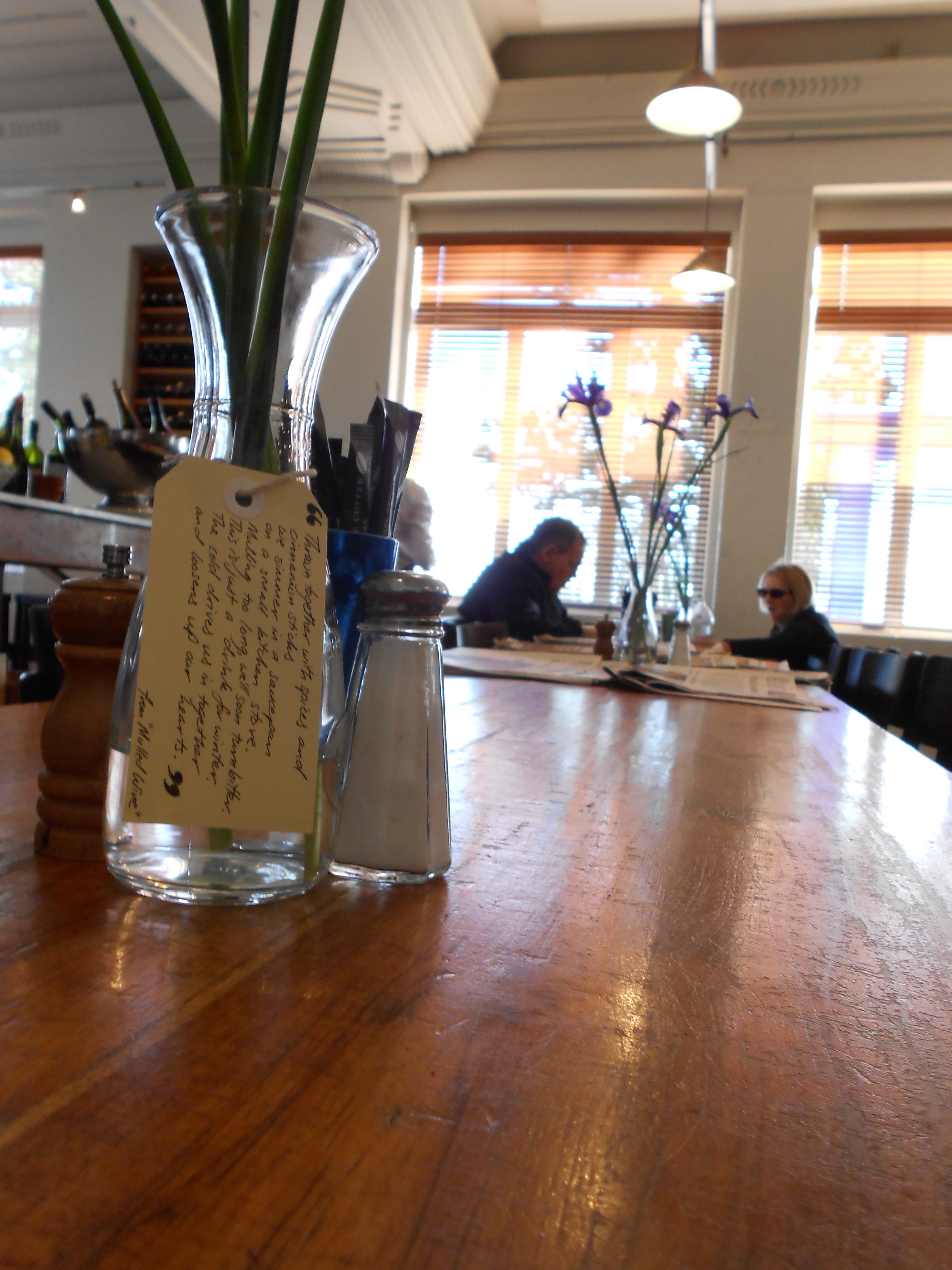
Patrons at Il Lido cafe, Cottesloe, can find poetry tagged on the table vases.

Il Lido Italian Canteen has been kind enough to take me on as their poet-in-residence, and now the fruits of that residency can be seen around the restaurant.

Il Lido decorates its tables with vases of fresh flowers that are changed regularly; some days I’ll be writing under the shadow of purple irises and other days it might be long-stemmed artichoke hearts. They’re just the kind of friendly touches that make Il Lido such a lovely place to go every week.

Now the vases have a new addition: ‘poetry tags’. Every other vase has a tag tied to it, and each tag carries an excerpt from one of my poems. Diners can read a grab of poetry while they eat, and maybe it’ll inspire them to check out some more local poetry.

Il Lido is on the corner of Marine Parade and Forrest Street, Cottesloe. I’m there every week, and I welcome company! To find out when I’m ‘Cafe Poeting’, follow me on Twitter: @perth_massive

Theatre People feature: “Perth: A Cultural Wasteland?” June 2011

Posts

This is an op-ed piece I wrote for Theatre People.

Earlier this year, reporter Liam Bartlett published an article in The Sunday Times entitled “Art’s a dirty word in WA”. In the article, Bartlett admonished Western Australia for being “culturally poor” despite our economic prosperity from the mining boom. This sentiment was recently echoed by international producer John Frost when he brought his joint production of Wicked to town. Frost fumed at WA, publicly stating, “You are the only State in the country that doesn’t have an arts centre and you are the wealthiest State in the country, supposedly. It is an outrage.”

Both Bartlett’s article and Frost’s comments have sparked much discussion within Perth’s arts community. Yes, Perth has always had a reputation for being an oversized country town that’s more concerned with footy than theatre, but is it fair to label us “culturally poor”? That kind of broad statement sweeps aside all the talented, committed creatives and arts workers in Perth who are tirelessly pumping life into the City’s arts community.

We’ve been working hard to shake off the moniker of “Dullsville”, but as usual we’re doing it at a glacial pace. With the mining industry’s help, Perth has the fastest expanding population in Australia. Our little city is growing up. But our perception of our city is slow to catch up, and the growing pains are indeed painful. In January, the new $100 million State Theatre Centre opened, the first theatre to be built in Perth by any state government. That is a massive step forward. However, the State Theatre Centre’s main stage ­– the Heath Ledger Theatre ­– only has a seating capacity of 575. The other stage seats 230. That’s small, even for Perth. (For comparison, the Regal Theatre seats 1074, and Burswood Theatre seats 2300.)  On top of that oversight, the venue is so expensive to use that WA’s flagship theatre company, Black Swan, has announced it may not be able to afford to put on its usual seven productions a year. So, somehow, the State government has managed to spend $100 million on making it more difficult for theatre to be produced in Perth.

No matter how much talent this state produces, it can’t flourish unless it has the infrastructure to support it. In the past few years, the City has spent millions of dollars on the public transport infrastructure, the main result of which was the extension of the train line to Mandurah. So now we can travel even further away from Perth. Great. But within the City, we still have very limited train and bus services after business hours, and taxis are prohibitively expensive, making it difficult and costly for residents from the suburbs to stay in the City after work. As a result, everyone crowds the trains and the freeways home at five o’clock every day, leaving the City relatively empty. After dark, Perth becomes a desolate wasteland of closed cafes and empty footpaths. I swear I saw a tumbleweed once. If the City was the kind of place more people wanted to hang around of a night, then they’d be more likely to go see a show, or drop into an art gallery, or listen to some live music. Instead, most people spend their spare time (and money) near their homes, out in the suburbs – nowhere near the few professional theatres that Perth has.

And then, of course there’s the long, painful debate about extended trading hours. This may not seem directly related to the arts community, but of course it is. If you go to see a show in Sydney or Melbourne, afterwards you can find a nice café or restaurant and sit down with your friends, grab a bite to eat, and discuss the play you just saw. The trip to the theatre becomes a night out, a relaxing and fun experience for everyone. However, in Perth, thanks to the limited trading hours, not many places are open on weeknights. Any restaurants that do stay open late usually close their kitchens before 9 p.m., so if the show you’re seeing finishes after then, you might as well just go home.

As a city, we’ve got the population size to warrant a bigger, more accommodating arts infrastructure. We’ve got the passionate, talented people needed to get a thriving theatre community going. At the moment, it’s like Perth is a tiny little fishbowl and we’re trying to grow whale sharks in it. It’s no wonder our best talent keeps outgrowing us and moving over to Melbourne, Sydney, or overseas. Perth’s theatre community may not be getting the support it needs from our State government, but that doesn’t mean we are “culturally poor”. I believe we are culturally rich, and we have the makings of a strong theatrical base here. Our theatre community is unfortunately scattered around the fringes of the city, in the suburbs, without a centre to hold us all together. Perhaps the new State Theatre Centre will be that rallying point for Perth’s theatre people. Perhaps not. Bartlett may have underestimated Perth’s cultural riches, but he was spot-on in assessing the lack of “cultural leadership” in WA. So, all we need now is a leader.

This Friday afternoon I’ll be holding the Perth edition of the NYWM Young Writers’ Workshop – 5pm at the Katharine Susannah Prichard (KSP) Writers’ Centre.

After the success of the Bunbury workshop, I’m very much looking forward to seeing what Perth’s young writers can bring to the table.

It will run for one hour, and we’ll talk about writing, getting started, and ideas for NYWM writing projects.

I’m also pleased to announce that we’ll have a special guest – Sj Finch, editor of dotdotdash and published author.

WHERE: The KSP Writers Centre, 11 Old York Road, Greenmount WA

WHEN: 5pm-6pm Fri 27 May

WHAT: Bring pen and paper, and be ready to write!

WHO: You, silly.

Although the workshop is free, you will need to reserve a spot if you wish to attend. CLICK HERE to let me know you want to attend.

Posts

Here’s a bit of smart-arsery I wrote for Edith Cowan University’s student magazine, GSM.

It has been out of vogue for a while, but we think the feminist movement might be poised for a come-back. So, GSM reviews feminism: hot, or not?

Feminism burst onto social scene in the 1700s, with the women’s suffrage movement. Oppressive patriarchy was hugely fashionable back then, but two tres chic Frenchwomen came up with a provocative new idea: women should be allowed to vote. Oh, la la! This new French trend started turning heads all over the world, until suffrage finally exploded in Britain.

Then feminism got really exciting. Not to be outdone by the French, the British suffragettes took extravagance to new levels. In London, 1907, the big look for Winter was ‘mud’ as over 3,000 chilly damsels marching through the sludgy streets. They were showing the British public their determination to be recognised as equal citizens, and they did it with breathtaking flair. Colours were dark, muted tones, with splashes of red and white. Protesters accessorised with matching red and white posies, bound with cute vintage hankerchiefs. And the girls really made a statement with their white banners and scarlet slogans. Feminism was hip; it was edgy. It was haute.

Of all the stylish ladies (and gents, John Stuart Mill!) who supported votes for women, none was hotter than suffrage it-girl Mrs Pankhurst. This gutsy goddess inspired countless women to starve themselves in the name of fabulousness. In the middle of one hunger strike, prison officials tried to barge into Mrs Pankhurst’s cell and force carbs down her throat. Our heroine raised a clay jug over her head and cried, “I shall defend myself!” The woman was fierce. Making civil rights fashionable was her lasting legacy – because, as she famously declared, freedom is to die for.

When women won the right to vote, the heady days of feminist militance and red posies seemed over. Feminism disappeared from view, only to return more fabulous than ever in the 60s. Feminist theory was back, and it was sexed-up. Fearless females were burning their bras (not designer, we hope!) and upping their erotic IQs. They were saying, ‘What if I don’t just want to be a wife and mother? What if I want to be a career girl, or a sex bunny, or a princess?’ YES. We loved the movement’s new mystique, and The Female Eunuch was a real page-turner, but sadly this new wave of feminism left us a little dissatisfied. After all those decades of fab fems working hard to get equal rights, it was still super hard for a girl to get ahead at work, and her bum was still getting pinched. By the time Y2K came around, we were pretty glum about the whole thing.

But all is not lost. Feminism may not be as exciting or as glamorous as it was last century, but it certainly has the classic appeal of self-righteousness. The movement’s central tenet – that life is way suckier for women than men – is hard to deny. A lot of the super un-fun stuff that women have to deal with (like childbirth, yuk!) is unique to the female sex. Men can never, ever understand what ladies go through, which is great for feminists – it gives them an edge in debates.

If you’re a white, middle-class woman living in a Western democracy, then feminism is a good fit for you. (If you’re a lesbian too, then bravo for going the extra mile!) For you, being a feminist requires very little maintenance. Mostly, all you have to do is keep being female. While one hundred years ago the suffragette sisters were starving themselves and risking beatings to defend their rights, now you don’t need to go that extreme. It’s easy to defend your rights; you don’t have to be employed, get an education, or even vote – you can simply say you’re exercising your right not to. Hurrah!

As social movements go, feminism is sounding pretty foxy, right? But wait. A lot of feminists you meet seem to wear comfortable shoes and hate men. Don’t worry, that doesn’t mean you have to! Follow these easy steps, and you’ll be prepared to respond to any questions about your feminism. In case a non-feminist challenges you, memorise this classic fact: ‘In Australia, women earn on average 17% less than men.’ (This is always a safe statistic to quote because it hasn’t changed in thirty years – it isn’t going anywhere!) Should a militant feminist ask you why you’re wearing heels and a Playboy bunny tee, simply learn this adjective: ‘post-feminist’.

So now you know all you need to become a fully-fledged feminista. You’ll feel smarter for being politically active, with the added bonus of moral superiority. Enjoy your newfound sisterhood, but remember one thing: never laugh at feminism. There is nothing funny about it.

Posts

NYWM interview: “Why I Write: David Vincent Smith”, May 2011

Posts

Today I posted my interview with David Vincent Smith (the man known as DVS) on the NaNoWriMo blog – we discuss writer’s block, David Wenham (swoon), and being poor.

Have a read:


DVS

I’ve just sat down for a chat with Perth writer and filmmaker David Vincent Smith, also known as DVS (pronounced ‘Devious’ – see what he did there?). DVS is one of Perth’s best performance poets, as well as one of the founders of Seventh Continent Productions. He has been featured at poetry and spoken word events around Perth (including Cottonmouth just last night), and was invited to be a guest at the 2011 Bali Emerging Writers Festival. And he’s twenty-three years old. When he saunters in with his scruffy beard and wide grin, you might mistake him for a bad Gen Y stereotype – but this is one of the hardest working young writers in Perth. READ MORE…

In preparation for National Young Writers’ Month (June), I’m running two Young Writers’ Workshops in WA. They’re aimed at anyone aged 12-25 who’s interested in writing and wants to kick-start their writing projects.

The first workshop is in Bunbury (eeyeah BunVegas!). Deets:

WHEN: 5pm, Monday 16 May

WHERE: Bunbury City Library’s Activity Room

HOW MUCH: Nada. It’s free.

The second workshop is in Perth (woo Perth!).

WHEN: 5pm, Friday 27 May

WHERE: Katharine Susannah Prichard (KSP) Writers Centre, 11 Old York Road, Greenmount WA

Places in each workshop are limited, so if you want to come along, pop a comment down below and I’ll get back to you.

Huzzah!

Posts

Poem: “The Bogan Rap (lyrics)”

Poems, Posts

I’m here today to tell you about a man – you might know him.

He is every man lining up for The Shed in Northbridge
and he is every man who still thinks Ben Cousins is a hero
and he is every man with a southern cross tattoo on his shoulder.
He bears the cross on his shoulder but, christ, he’s not Jesus
(though he may wear sandals wherever he pleases).
He’s crackin’ a can of coke and Jack Dan
and lurching at me with his drink in his hand
and I’ve seen him, leaning out his Commodore,
keening on me like I’m a common whore.
I’ve got class, man, I like a conversation.
Been to uni and got me an education.
Yeah! This shit’s tertiary, bro,
and I think you should know
to use your head
use your head
use your head
use your head.
Like John Stuart Mill said,
SHOW BITCHEZ RESPECT.
Show bitches respect, show bitches respect,
like Johnny Mill said, show them bitches respect.
…Uh, yeah, that’s not quite what Mill said,
but you know what I meant,
though using the term ‘bitch’ was a detriment to my argument….
But I digress. Yes! Express my words with finesse.
Though this bogan everyman is causing me real stress,
‘coz he’s the loudest and the meanest and he’s got cash, too,
and he’s traded up the flannel for Armani suits
so he’s harder to find. But the state of his mind will divide
him from the other blokes every time that he gets blind.
‘Coz in his head, the world is neatly split into two –
so it’s me and it’s you
it’s yours and it’s mine
it’s black and it’s white
it’s us and it’s them and it’s them and it’s us
and everyone owes him
and it’s not his fault
and his only ambition in life
is to drink every weekend and have a hot wife.
Such is life! I guess this is
the life of his missus –
tradin’ her freedom for his seldom kisses.
So take your coke and your Jack
and a big step back,
‘coz if you’re crackin’ on me, I feel sorry for ya, son.
I got 99 problems but a bogan ain’t one.

Hit me.

Poem: “Driving”

Poems, Posts

I can feel sleep creeping upon me,
threatening with oblivion.
My mind fights it like an ageing despot
refusing to retire, to become irrelevant,
convinced that the world will
fall to pieces in its absence.
I lean back in the passenger’s seat
and my mind whirrs on, unchecked.

Clouds sail on an urgent wind,
in the middle space between
the human scale and the infinite.
A shadow leaps onto a wall,
and for a moment all the lines are clear.
Then it is snatched away, and there is
only the blur of concrete.

We drive until it is dark,
until the street lights wink on.
The river’s black water betrays
the fluorescent inverted world.
Ruby, sapphire strata
stretch down to the depths,
spearing away from the land.

The overhead lights stripe
the dashboard yellow, flicking along
with metronome precision.
At the sound of street rushing
past beneath my feet,
my eyes close and I doze
like a fussing baby held close
by a tired mother.

Between slow, lengthening blinks,
I peer at the scenes swinging past.
A couple weaves its way
towards the city centre,
pinky fingers linked between them.
They have the languid gait of lovers.
Seagulls are wheeling in the air,
rising like a pale cloud
behind the darkness.
A man runs a hand through his hair,
standing with feet apart at the bus stop.

Glancing to my right,
I watch the capable hands
guiding the steering wheel.
Then, just the right song
crosses the radio.
The world eases by outside,
confident in itself.
Reassured by the constant motion,
my mind gives up control, slows,
and finally drifts into oblivion.