Cottesloe set to get poetry-bombed this weekend

Posts

We are currently in the midst of National Poetry Week (5-11 September), an initiative by Australian Poetry to WRITE, BUY, SHARE, LIVE and CELEBRATE this engaging artform.

I’ve been the Cafe Poet at Il Lido Italian Canteen, Cottesloe, for the past three months, and I plan to celebrate NPW by dropping a poetry-bomb on Il Lido this Saturday and Sunday. It’s an event I’m calling CHALK LINES.

People having lunch at Il Lido this weekend will find that poetry has crawled across the footpath, leapt onto their tables, squeezed itself into their sugar packets and burst against the walls.

Carol Ann Duffy, Britain’s poet laureate, said, “Poetry is all around us, all of the time.” And this weekend, this literary sentiment is going to become quite literal for the patrons of Il Lido.

Find CHALK LINES on Facebook.

Runner-up in WA Poetry Festival SLAM!

Posts

Photo courtesy of Allan Boyd (2011)

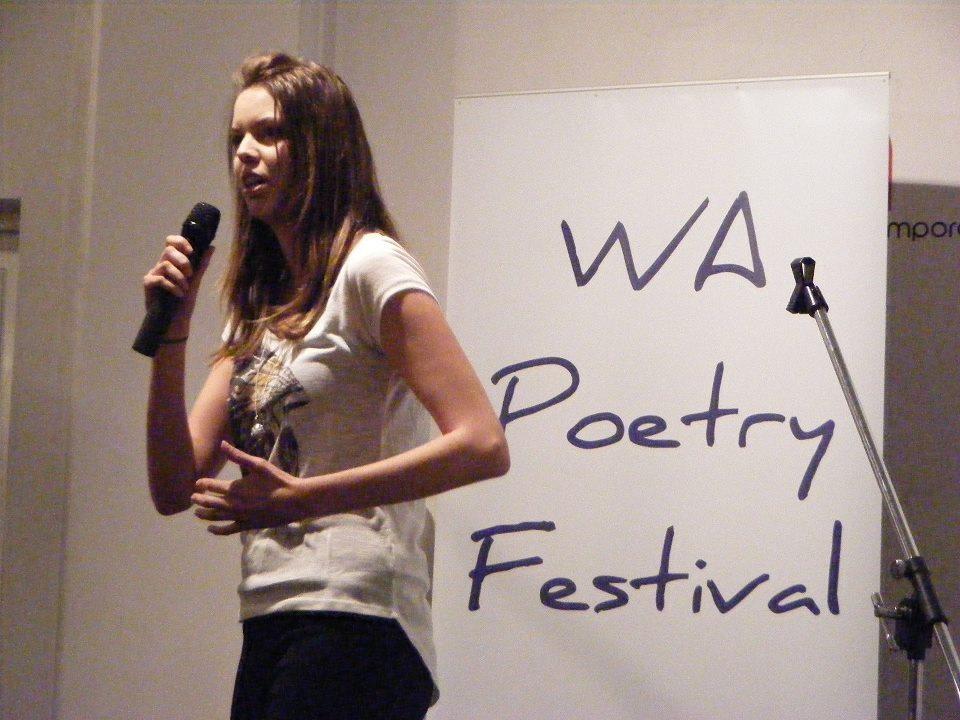
Last night was the WA Poetry Fest’s Slam. It was a fantastic night with an entertaining mix of old hats and new faces. We had an impressive line-up of 20 poets, but most notable were Janet Jackson‘s gorgeous pagan tribute to the moon, and James Hanlon’s touching tribute to his dad, which he ended with a big ol’ dad hug (Mr Hanlon was in the crowd).

And of course, DVS‘s rap ‘Pixel Junkie’ was fun and thought-provoking, and took out first place. DVS is devious indeed, and one of these days I’m actually going to beat that guy in a slam. One day …

But it was pretty sweet to take out second place with my slam of ‘Yeah Orright Princess’, and rack up the highest score I’ve ever gotten in a slam.

Bloody good night.

Theatre People review: “The Yellow Wallpaper”, Sept 2011

Posts

This is a review I wrote for Theatre People of a theatrical adaptation of the famous short story, ‘The Yellow Wallpaper’.

The Yellow Wallpaper is a new Perth production based on Charlotte Perkins Gilman’s gothic short story of the same name, adapted for stage by Silvia Lehmann and Teresa Izzard. This beautiful play gives a twisted physicality to the tale of a woman, Charlotte, who is struggling to cope after the birth of her first child. Her husband, a doctor, prescribes a ‘rest cure’ – a popular remedy for ‘hysterical tendencies’ in 1892. Stuck in the upstairs nursery with nothing but her imagination and the wallpaper, the woman desperately searches for an escape.

The role of Charlotte is shared between two actors – Jo Morris and Sarah Nelson. Morris is captivating as the ‘real’ Charlotte, the one still anchored in reality, while Nelson represents the part of Charlotte’s mind that she keeps hidden. From the very beginning of action, the two women are in perfect sync; they mirror each other’s movements around the stage in a way that is both fascinating and slightly unsettling. As Charlotte’s mental state deteriorates, the line separating the two women blurs, culminating in a breathtakingly disturbing choreography at the end.

Charlotte’s husband (Sean Walsh) orbits around the edge of the set. He sits to one side of the stage throughout the play, reading medical books in his winged armchair, an immediate symbol of nineteenth-century masculine authority. Walsh is perfect as the logic-minded doctor who treats his wife with fatherly condescension. The doctor ignores his wife’s pleas for help, insisting that she would get better if she would only practise some self-will. As infuriating as his character is, Walsh doesn’t let him descend into a monstrous figure; he makes him human, a man who is well-meaning but getting it completely wrong.

Though there are only three principals in The Yellow Wallpaper, I feel I should name a fourth: the wallpaper itself. Laura Heffernan’s brilliantly crafted set, complemented by clever lighting design from Karen Cook, gives the peeling yellow wallpaper a life of its own. The actors interact with the paper until it has a towering presence in The Blue Room’s small theatre; they stare into it, tear strips off it, and rub its dust onto their clothes. Silhouettes dance behind it and disembodied eyes blink through secret holes. It is delightfully creepy.

Perkins Gilman’s original story was composed of a first-person narrator’s journal entries, and I was curious to see how Lehmann and Izzard would flesh out the parts of the story that were left unwritten. For instance, the woman is never named in the original text, but in the play her name becomes Charlotte, an evident nod to the author. Except for a couple of changes, the play keeps true to the brooding drama and moments of black humour that made The Yellow Wallpaper such an arresting tale. However, I thought one of the company’s interpretations of the story was a bit odd: as Charlotte deteriorates, so does her husband. Charlotte’s decline into madness would have had more impact if it had been contrasted by the husband’s stoic belief in reason. Instead he was reduced to a crawling, collapsing wreck, which seemed uncharacteristic. This, perhaps, was why the play did not reach a stronger climax at the end; I think the audience was waiting for a more violent conclusion to Charlotte’s condition.

Despite an uncertain finale, The Yellow Wallpaper is a truly stunning production by Perth physical theatre company Movementworks. And, with a relatively short running time and no intermission, it holds the audience’s tense attention from start to finish.

The Yellow Wallpaper is showing at The Blue Room until Saturday, 3rd September 2011.

Poem: When Cafe Poets get writer’s block

Poems, Posts

In this untitled poem, a cafe poet struggles to justify the last hour and a half she spent staring at a wine rack.

It’s good to have this time to write

each week; not waiting ’til the time is right

but sitting down and spitting out some rhymes.

I’m of the opinion that it’s a sin to have no discipline,

so this time has a lot of merit. But I think that I could bear it

much better if I could just think of something the f**k to write.

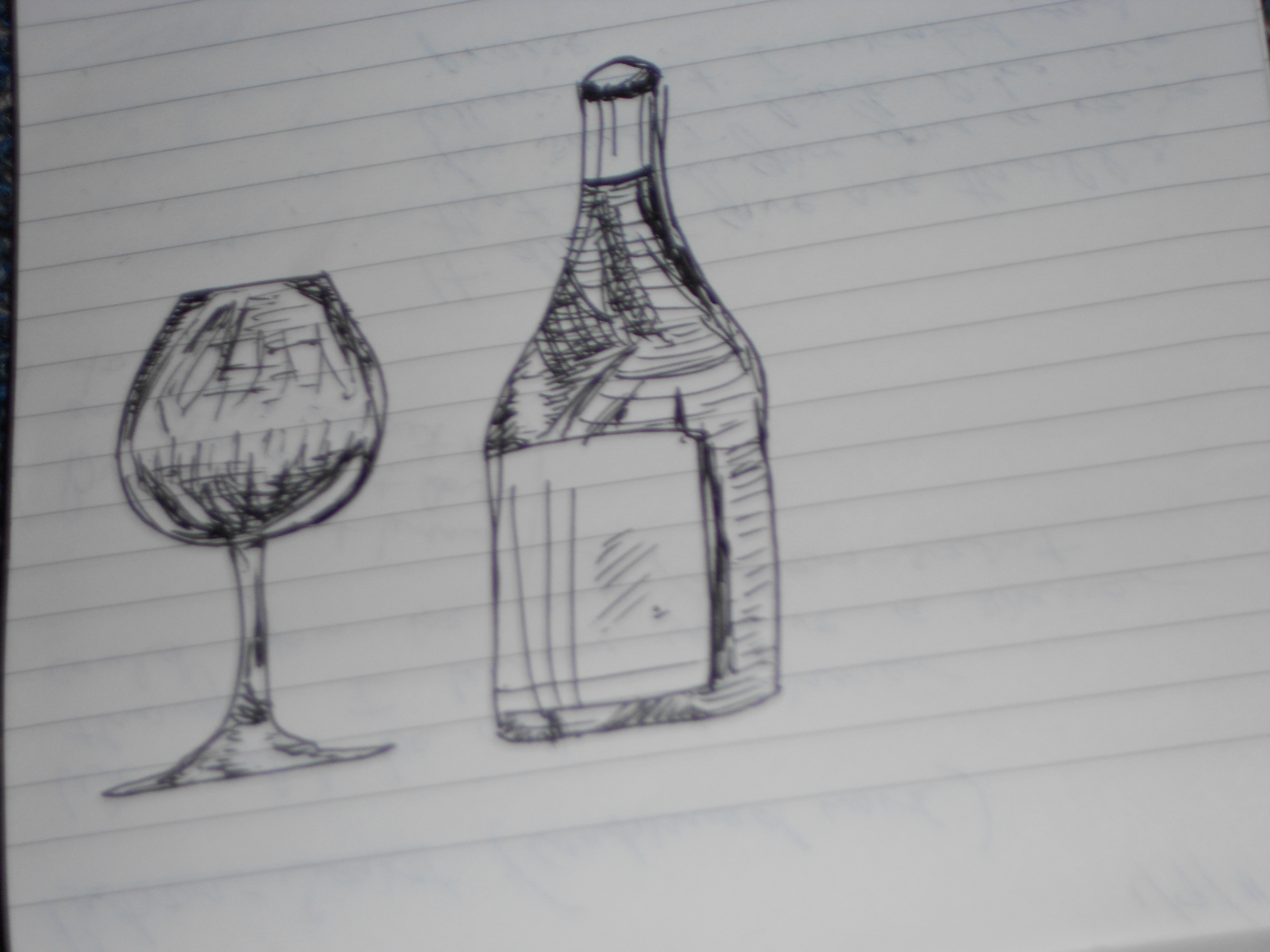
I did draw a pretty nice picture of a wine glass.

Not the Mona Lisa.

Cafe Poet update: Putting poetry on the table

Posts

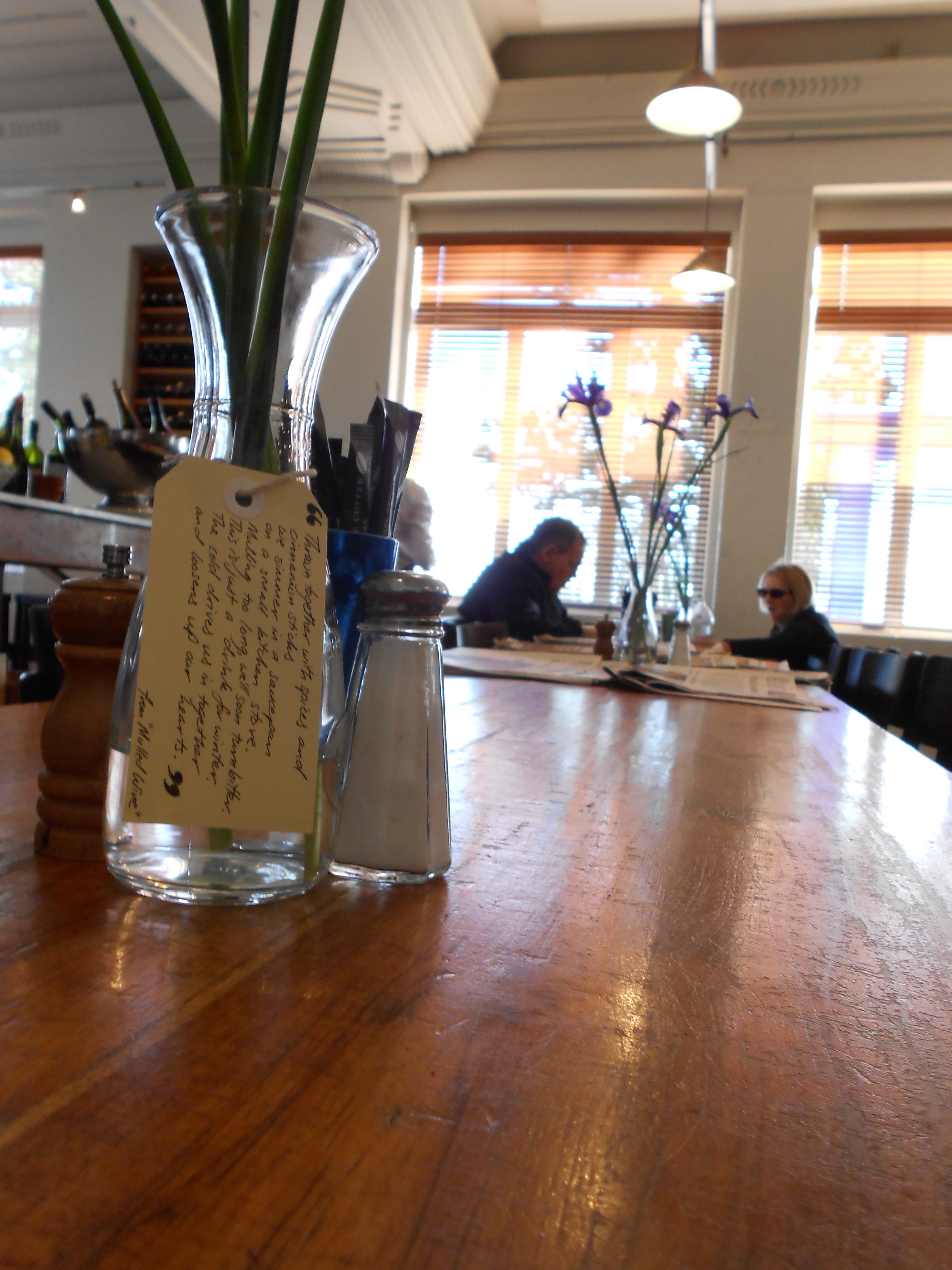
Patrons at Il Lido cafe, Cottesloe, can find poetry tagged on the table vases.

Il Lido Italian Canteen has been kind enough to take me on as their poet-in-residence, and now the fruits of that residency can be seen around the restaurant.

Il Lido decorates its tables with vases of fresh flowers that are changed regularly; some days I’ll be writing under the shadow of purple irises and other days it might be long-stemmed artichoke hearts. They’re just the kind of friendly touches that make Il Lido such a lovely place to go every week.

Now the vases have a new addition: ‘poetry tags’. Every other vase has a tag tied to it, and each tag carries an excerpt from one of my poems. Diners can read a grab of poetry while they eat, and maybe it’ll inspire them to check out some more local poetry.

Il Lido is on the corner of Marine Parade and Forrest Street, Cottesloe. I’m there every week, and I welcome company! To find out when I’m ‘Cafe Poeting’, follow me on Twitter: @perth_massive

Grok article: “The Trouble With Kindle”, July 2011

Posts
This is an article I wrote for Curtin University’s student magazine, Grok.

Things are looking bad for books. With REDgroup going bankrupt, leading to the closure of dozens of bookstores around Australia, it seems that the traditional book is plummeting towards obsolescence. Though the killing blow has yet to be dealt, it seems inevitable that all bookseller chains, independent bookshops and book exchanges must soon go the way of Angus & Robertson. The demise of the traditional book has been a long time coming, but the final nail in its papery coffin has to be the invention of electronic book readers. Most especially, Kindle.

Kindle is to reading, as David Tennant is to the Doctor Who franchise. Kindle took what ordinary books had been doing for ages, and did it BETTER. And even though there have been other e-readers since, Kindle is still the one that people remember. So what is the big whoop? People say, “Why not just read off your computer, it’s basically the same thing, right?” NO. The Kindle uses electronic ink, which means that it looks just like printed ink. I’m not a techie, I don’t know all the terminology. I just know it’s a magic page that can erase itself and become any page out of ANY BOOK EVER. (Provided Amazon’s online store carries that book.) It’s MAGIC.

Now, I am not the most up-to-date person, technologically. I was made aware of this by the expression on a Dick Smith employee’s face when I asked him where I could find the “cassette tape section”. (He was like, “Uh, maybe in 1992?”) Also, the other day I had to consult a younger friend on whether it is “cool” to refer to Facebook as “Facey-B” (side note: it is not). At the age of twenty-four, it seems I am already slipping into the grey irrelevance of middle age. But I have one redeeming feature that makes me seem hip and trendy: I own a Kindle. And, by god, I love it.

There, I said it: I LOVE MY KINDLE. I – a Penguin-Classics-tote-bag-carrying English Lit major – LOVE MY ELECTRONIC READING GADGET. But it is a love that is tinged with bitterness. Every time I curl up in bed with my shiny Kindle, I feel like I’m cheating on paperbacks. I worry that I am single-handedly closing down another struggling bookseller. Every time I download another Nora Roberts, a Borders angel cries.

I don’t want to hurt bookshops; I adore bookshops. No matter how much I love the efficiency of sitting at home, thinking “I really want to read that book by that guy” and then downloading it moments later – no matter how convenient that is, it doesn’t replace the experience of wandering through the stacks of a bookshop. It doesn’t replace that feeling of weighing a thick novel in your hand, and thinking “I am going to devour all 1200 pages of this mofo, and it is going to be amazing”. Or cracking the spine of a new book. People didn’t line up to download the new Harry Potter. They wanted something they could touch, hold, maybe even cuddle at night (what?).

However, Kindle has an advantage that I did not anticipate: when you’re reading from a Kindle, no one can tell what you’re reading. You could sit on the train perusing some trash – like Justin Bieber’s unofficial biography, or amateur romance novels – without having to hide the cover behind your knees. Now I can sit in public and read 100% Bieber without a trace of self-consciousness. And if anybody asks what I’m reading, I can just flick over to James Joyce and be all smug and literary.

But herein lies my biggest problem with e-books: they make it harder to show off. If no one can see what you’re reading, it means they also can’t be impressed by how erudite and charmingly bookish you are. I mean, sure, sometimes I read books that have shirtless men on the cover, but I also read obscure Gothic novels from the nineteenth century. I’ve got literary cred, yo. But the anonymity of my Kindle effectively erases the possibility of having a “meet cute” with an attractive stranger in a cafe who stops to exclaim that he, too, is a fan of Hemingway. Nope, he’s going to walk right on by the girl with the Kindle, never suspecting that we were so perfect for each other. Instead, flaunting my Kindle in a cafe would probably only attract Mac zealots who want to evangelise about the iPad 2. My voracious reading habits had only one social advantage, and that was appearing intellectually superior to other people. With my Kindle, I haven’t even that. (At least this means I no longer have to read Murakami or Vonnegut – because what’s the point if no one sees you reading them?)

My Kindle is no good for showing off my reading prowess, but I love it all the same. I know I’m hurting books, but I can’t seem to stop myself. I am seeing my Kindle almost every night, and spending less and less time with my papery friends. Every now and again I go to a bookstore and buy a stack of books, in a fit of guilt. I tell books they’re the only ones for me; while I strayed, my heart was always theirs. But there, at the bottom of my tote bag, lies the Kindle …
Theatre People feature: “Perth: A Cultural Wasteland?” June 2011

Posts

This is an op-ed piece I wrote for Theatre People.

Earlier this year, reporter Liam Bartlett published an article in The Sunday Times entitled “Art’s a dirty word in WA”. In the article, Bartlett admonished Western Australia for being “culturally poor” despite our economic prosperity from the mining boom. This sentiment was recently echoed by international producer John Frost when he brought his joint production of Wicked to town. Frost fumed at WA, publicly stating, “You are the only State in the country that doesn’t have an arts centre and you are the wealthiest State in the country, supposedly. It is an outrage.”

Both Bartlett’s article and Frost’s comments have sparked much discussion within Perth’s arts community. Yes, Perth has always had a reputation for being an oversized country town that’s more concerned with footy than theatre, but is it fair to label us “culturally poor”? That kind of broad statement sweeps aside all the talented, committed creatives and arts workers in Perth who are tirelessly pumping life into the City’s arts community.

We’ve been working hard to shake off the moniker of “Dullsville”, but as usual we’re doing it at a glacial pace. With the mining industry’s help, Perth has the fastest expanding population in Australia. Our little city is growing up. But our perception of our city is slow to catch up, and the growing pains are indeed painful. In January, the new $100 million State Theatre Centre opened, the first theatre to be built in Perth by any state government. That is a massive step forward. However, the State Theatre Centre’s main stage ­– the Heath Ledger Theatre ­– only has a seating capacity of 575. The other stage seats 230. That’s small, even for Perth. (For comparison, the Regal Theatre seats 1074, and Burswood Theatre seats 2300.)  On top of that oversight, the venue is so expensive to use that WA’s flagship theatre company, Black Swan, has announced it may not be able to afford to put on its usual seven productions a year. So, somehow, the State government has managed to spend $100 million on making it more difficult for theatre to be produced in Perth.

No matter how much talent this state produces, it can’t flourish unless it has the infrastructure to support it. In the past few years, the City has spent millions of dollars on the public transport infrastructure, the main result of which was the extension of the train line to Mandurah. So now we can travel even further away from Perth. Great. But within the City, we still have very limited train and bus services after business hours, and taxis are prohibitively expensive, making it difficult and costly for residents from the suburbs to stay in the City after work. As a result, everyone crowds the trains and the freeways home at five o’clock every day, leaving the City relatively empty. After dark, Perth becomes a desolate wasteland of closed cafes and empty footpaths. I swear I saw a tumbleweed once. If the City was the kind of place more people wanted to hang around of a night, then they’d be more likely to go see a show, or drop into an art gallery, or listen to some live music. Instead, most people spend their spare time (and money) near their homes, out in the suburbs – nowhere near the few professional theatres that Perth has.

And then, of course there’s the long, painful debate about extended trading hours. This may not seem directly related to the arts community, but of course it is. If you go to see a show in Sydney or Melbourne, afterwards you can find a nice café or restaurant and sit down with your friends, grab a bite to eat, and discuss the play you just saw. The trip to the theatre becomes a night out, a relaxing and fun experience for everyone. However, in Perth, thanks to the limited trading hours, not many places are open on weeknights. Any restaurants that do stay open late usually close their kitchens before 9 p.m., so if the show you’re seeing finishes after then, you might as well just go home.

As a city, we’ve got the population size to warrant a bigger, more accommodating arts infrastructure. We’ve got the passionate, talented people needed to get a thriving theatre community going. At the moment, it’s like Perth is a tiny little fishbowl and we’re trying to grow whale sharks in it. It’s no wonder our best talent keeps outgrowing us and moving over to Melbourne, Sydney, or overseas. Perth’s theatre community may not be getting the support it needs from our State government, but that doesn’t mean we are “culturally poor”. I believe we are culturally rich, and we have the makings of a strong theatrical base here. Our theatre community is unfortunately scattered around the fringes of the city, in the suburbs, without a centre to hold us all together. Perhaps the new State Theatre Centre will be that rallying point for Perth’s theatre people. Perhaps not. Bartlett may have underestimated Perth’s cultural riches, but he was spot-on in assessing the lack of “cultural leadership” in WA. So, all we need now is a leader.

Yesterday was the final day of National Young Writers’ Month, and it was a bittersweet day. It was sweet because I completed my NYWM goal of 10 poems before 30 June (one of them was a haiku, which is a bit like cheating, but still). But it was sad to say goodbye to NYWM when I’ve had such a good time being its ambassador.

BUT the fun isn’t over just yet! We’ve just over a week before the NYWM Closing Party / Voiceworks 85 “OTHER” Launch! The launch will be hosted by the distinguished Byron Bard, and will feature performances by:

Mathas

Tomas Ford

Amber Fresh

Caroline J. Dale

with readings by Voiceworks contributors.


The Moon Cafe, from 3pm on Sunday 10 July. It’s gonna be delicious.


Posts

The successful Theatre People website has been a part of Victoria’s theatrical community for eleven years, and now they’re expanding to the national level. I’m proud to have been selected as the editor of Western Australia’s branch of Theatre People, and I’m looking forward to August when the website relaunches nationally.

I know there are plenty of theatre-y people kicking around WA, so if any of them would like to get involved with Theatre People, my email is kaitlyn at theatrepeople dot com dot au. I’ll need feature writers, reviewers, and people with their fingers on the pulse of Perth’s theatre community.

Read Theatre People’s official announcement!

Posts