The kind of girl I want to be

Posts, Selected Posts

So, last night I watched Gangster Squad. It was alright. My housemate and I had grabbed the DVD from the shops and headed home with some burgers. It was a pretty sweet plan – we were both in the mood for action, and I loved the line-up of actors. Emma Stone, Ryan Gosling? Sean Penn being insane? Nice.

But by the second half of the film, I was wriggling around in my seat, grunting to myself. I sat forward, threw my hands up. Yelled some half-sentences at the screen. “But what is she–” … “But why doesn’t he–?” … “BUT YOUR WIFE IS–!!”

Something was really bugging me, and it wasn’t just the awkward direction or the under-developed characters. (All of those A-grade actors were working so hard to make something out of that script, but man, they didn’t have much to work with.)

I was getting seriously bugged by the female characters in the film. Emma Stone’s character – what are her motivations? Why does she hang off the arm of that psycho gangster? The only explanation we get – “I came to this town to be a star”. Come on. “I came here to be a star, but that didn’t work out, so now I’m dating the bloodthirstiest mob boss on the west coast”? What? It was hard to see such a paper-thin role inhabited by the gifted comedic actor of Easy A. I mean, she brought the world this:

The only other named female character in Gangster Squad was the sergeant’s pregnant wife. She was clever and tough as nails, but she still spends most of the film being abandoned by her husband.

The thing I was having trouble articulating to my housemate, a dude of the dudest order, is that movies like these make me feel a bit left-out. I don’t see myself in these movies. I love action, I love thriller, but the only people who look like me in them are not the heroes. I’ve never seen myself in the role of dependent girlfriend or long-suffering wife. Growing up, I didn’t dream of waiting at home to find out what was going on. These weren’t the character types that spoke to me.

I wanted to be Ryan Gosling, smooth-talking with a heart of gold. I wanted to be the straight-shooter, pinging tin cans out of the sky with a knowing wink. I wanted to be that “one man” (in movie voice) who saves the world. I wanted to be Will Smith punching aliens; Keanu Reeves stopping bullets; Tobey Maguire discovering he could climb walls with his fingertips. I wanted to be MOTHER-FLIPPING WOLVERINE.

But I’m a lady.

You might be excused for thinking I’m gender-confused, wishing I was Hugh Jackman or something, but that ain’t it. It’s not me who’s confused about my gender – it’s Hollywood. Women are categorically more interesting, varied, and powerful than is represented in cinema. No wonder that, when I’m watching the latest blockbuster, I find myself relating more to the male characters for their appealing array of courageous and tenacious heroes.

There have been flares of cinematic womanhood that have dazzled my weary eyes, such as Hermione punching Malfoy, or Lara Croft: Tomb Raider, or Pocahontas diving off a cliff with zero fear. And, I know I bring it up a lot, but The Hunger Games. These characters are self-possessed, capable, at home in their surroundings. They have that thing inside them, a special power. That’s what so many female characters in cinema lack: an internal power. Their power is more often derived from external sources (usually whomever they’re letting lie on top of them at night).

SPOILER ALERT: Do not read past here if you haven’t seen Season 2 of Game of Thrones yet and you still want to be surprised.
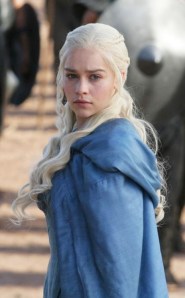
Daenerys Targaryen, "Game of Thrones".

Daenerys Targaryen, “Game of Thrones”.

I think that’s why Daenerys Targaryen of Game of Thrones has gathered such an intense following among fans: She is the Khaleesi. She started off a meek, oppressed, pretty little thing who did what the men around her said. Then, she walked into a fucking bonfire with some dragon eggs and everyone was like HOLY SHIT. No one told her to do that; she felt it intuitively. It came from inside her, a special power that she possessed. I love that. She isn’t a perfect feminist icon, but as Caitlin Moran recently tweeted (in response to the overthrow of Prime Minister Julia Gillard): “[F]eminist role models don’t need to be perfect. Currently, they just need to exist”.

They exist in real life (see: Wendy Davis). I’m damn sure they could comfortably exist in our imaginary lives, as well.

US Senator Wendy Davis. (Dragon probably photoshopped.)

Five movies that are bad for girls

Posts, Selected Posts

For most of last year, I worked at a private boarding house for girls. I was a “housey”.

My boarders were very bright, active, educated young women who could keep any housey on her toes. When lining up for dinner, they were fierce analytical negotiators. At bedtime they were tireless prosecutors. (“But miss, you let the Year 8s stay up for Glee!”) They navigated the politics of teenage girldom with strength and canniness and a freakish understanding of their complex social web.

But when it came to Movie Night, they only wanted one thing. Stupidity. Frequent, continuous stupidity. Preferably delivered to them in a cute dress.

They wanted the stupid, vapid, often offensive films grouped under the umbrella of “rom-com”. They wanted them without exception, and they would accept no other genre.

I despaired of the boarding house’s DVD library, which contained almost exclusively films about romance (with the exception of Milo & Otis … which is really more of a bromance). In school, these girls were privy to the best academic education our state had to offer. But their education in love and relationships was informed by How To Lose A Guy In 10 Days.

So, for months, I had to watch Amanda Bynes finish every story arc with “See! It’s OK that I’m a strong woman, because look, boyfriend!”, while my brain screamed to itself.

I tried to counteract this pro-stupid bias by delivering mini-seminars at the end of each movie. “Alright girls, who could see what was wrong with that ending? Should she have risked her career so that he wouldn’t feel ’emasculated’?” My lectures were met with replies such as “Shut up” and “Miss, don’t ruin this for us”.

I watched nearly all of those movies with the girls (and quite a few in my spare time). I’m not saying I don’t enjoy watching them. I do. I really, really do. But I also watch other genres of film, and, I might point out, I have enough life experience to realise that Matthew McConaughey is not going to sweep me away on his motorcycle. Those rom-com stories are all about exceptions to the norm: weird – and therefore funny – situations. But the girls watch them uncritically, accepting them as their ideal romance. When they collectively cooed in awe as Edward decided he did, after all, want to be with Bella, after breaking her heart and abandoning her without explanation, I wanted to bash my own head in.

So, rather than bash myself (because then the rom-coms win!), I choose to word-bash these films in this blog. I choose to NAME and SHAME.

I wanted to title this list “Top Five Movies That Young Girls Shouldn’t Watch Without An Accompanying Lecture And Discussion Workshop Analysing The Oppressive Discourses At Work On Them”. But it wasn’t snappy enough. Here, instead, is my list of Five Movies That Are Bad For Girls.

5. Friends With Benefits / No Strings Attached / any film in which casual sex leads to the guy falling deeply in love with the girl

These movies are just setting girls up for a fall … and possibly herpes.

4. Pretty Woman

Prostitution leads to the guy falling deeply in love with the girl … See above.

3. 10 Things I Hate About You

Yeah, I know, BUT HEATH LEDGER! I agree. He is dreamy. And while I adore this film, the ending makes me go “But whaaaaat?” Let’s remember that Heath spends most of the film conspiring with a motley group of teenage boys to trick Julia Stiles into dating him so the other guys can swarm on her sister. Somewhere along the line, Heath actually begins to notice that Julia’s a rockin’ babe. However, he continues to accept bribes to date her, and lies to her about things like quitting smoking. Julia finds out and, hurt by his betrayal, gets mad. Really mad. (Not surprisingly.) Still the bravest person in the film, she expresses her bewilderment in a poem that rhymes really badly. Heath listens with a pained expression. With so much trust lost between them, and such a betrayal on Heath’s part, you’d think it would take something huge to– oh wait, he bought her a guitar. He bought her a guitar! Rather than do something trite and mediocre like APOLOGISE, he bought her a guitar. And when she expresses her need to rebuild trust with him, he stifles her by forcing his face onto hers. All is better! Cue grunge music!

2. The Twilight Saga: New Moon

Pointing out chauvinism in the Twilight series is like shooting fish in a barrel, so I’ll keep this brief. Bella loves Edward! Edward loves Bella! But wait, Bella’s blood makes Edward’s family want to kill her. Bella wants to work through this problem, because their relationship is important to her, but Edward knows what is good for Bella BETTER THAN SHE DOES. He dumps her, without explanation. Bella is sad! Bella sits on a sofa without moving for several months! Then she jumps off a cliff! Only solution when your boyfriend leaves you! Wait, Edward needs her! Then, ignoring safety for herself, Bella needs to help him! Edward’s back, yay! He’s chastising her for not understanding that he did it for her own good, but he’s back! All better!

1. How To Lose A Guy In 10 Days

This blog post begins and ends with Kate Hudson. I’ve probably seen this movie upwards of a dozen times. It’s like a bag of stale popcorn: if it’s in front of me, I’ll probably finish it. Yet, the ending never fails to make me mad. The set-up of this film is that Kate Hudson is bored with her job writing fluff pieces for a women’s magazine. She wants to write about politics, world events, substance! Matthew McConaughey is a jock with an overwrought torso who boasts that he could make “any woman” fall in love with him within 10 days. (What a catch!) Something something they fall in love something then they find out they’re both being played and things fall apart. Clearly, their relationship (which only began less than two weeks ago, I’ll point out) was built on shaky foundations. There is a lot of trust lost. Out of this fiasco, Kate finds the strength to quit her boring column, and leaves New York pursue her dream job. Yay Kate Hudson! But wait, who’s this driving his motorcycle recklessly through peak hour traffic? It’s your dream guy! The one who sees women as interchangeable and dated you on a bet with his boss! He’s telling you not to leave him, because he JUST REALISED he loves you, and he thinks it’s stupid for you to move to Washington for your job, because HE is in New York! “You can write anywhere!” Duh, Kate Hudson! Now he’s ordering your cab driver around and singlehandedly deciding that you’re not moving, after all. Aren’t you lucky that you have such a handsome, strangely-tanned man to make decisions for you? BLERGH.

Where are the women slackers?

Posts
"I just want to watch Community in my pajamas! Damn you patriarchy!!"

“I just want to watch Community in my pajamas! Damn you patriarchy!!”

I have been enjoying the series America In Primetime on SBS for the past few weeks, but since watching it, something has stuck in my “craw” (ew).

It’s not just the deficit of female writers depicted. We get it, the patriarchy, whatever. They did a whole episode on the feminist movement as played out in American sitcoms. We’re getting there (I guess).

But then there was the whole televisual glorification of the slacker. The apathetic individuals who make an art out of doing nothing. Judd Apatow, Jerry Seinfeld, Beavis and Butt-Head, Judd Apatow. All definitely, repeatedly, male. And I thought, where are the woman slackers?

Women in primetime sitcoms are rarely slack. Even when we (our fictionalised television versions) get equal rights at work, sexual liberty, capri pants et cetera, we can’t use these newfound freedoms to spread out on the couch and eat a tub of yoghurt. Mary Tyler Moore is carving out a career, Lucy is busily fleeing Ricky, and Liz Lemon is trying to “have it all”. Sookie Stackhouse is fighting vampires, then fighting for vampires, then fighting werewolves AND vampires, all while holding down a waitressing job at Merlotte’s. Not one of these characters is wearing a Metallica t-shirt and saying “huh-huh” a lot. Not one female Butt-head!

Our only female slacker role model in American sitcom-land is Elaine Benes. Ah, Elaine. Hanging out with Jerry, George and Kramer, talking about nothing. The same thing, year in, year out. As far as I can tell, she was never too concerned with climbing the career ladder (wasn’t she kind of a butler for a while?) and she floated in and out of relationships (classic quote to on-again-off-again boyfriend Putty: “That’s it. We’re broken up for the rest of today”).

But Elaine was a slacker in a show that abounds with slackers; she is easily eclipsed by George Costanza. Easily. Even at her least ambitious, Elaine cannot compete with George’s effortless lack of effort.

The slacker is celebrated in plenty of primetime shows – The Simpsons, Seinfeld, Cheers (I mean, Norm and Cliff, come on, get out of the bar once in a while) – but he is dominantly male. Female characters are either satellites around the male characters (Marge flusters around Homer, cleaning up his messes) or they are only given independent status if they are hyper-driven, alpha-females with no time to be slobs.

I say, hey, Patriarchy, stop boxing me in. Quit hemming in my horizons. People always talk about the glass ceiling, well, what about the glass floor? Underneath my feet is a scungy basement filled with Seth Rogens and young Keanu Reeveses, enjoying a life of unabashed apathy, never questioning their right to play video games all day and eat Doritos. I can see this life: I can almost taste the cheese-flavoured dust on my fingers. But I can’t break through this floor. Society keeps urging me ever upwards, demanding ever more ambition and hard work; exhorting that I prove my gender made the right decision to agitate for the vote and equal rights. I must prove this by excelling at all aspects of my life. But what if I don’t want to be a doctor? Or a working mum? Or even working?

What if I want to be a slacker?

Equal rights, baby.

Here’s a bit of smart-arsery I wrote for Edith Cowan University’s student magazine, GSM.

It has been out of vogue for a while, but we think the feminist movement might be poised for a come-back. So, GSM reviews feminism: hot, or not?

Feminism burst onto social scene in the 1700s, with the women’s suffrage movement. Oppressive patriarchy was hugely fashionable back then, but two tres chic Frenchwomen came up with a provocative new idea: women should be allowed to vote. Oh, la la! This new French trend started turning heads all over the world, until suffrage finally exploded in Britain.

Then feminism got really exciting. Not to be outdone by the French, the British suffragettes took extravagance to new levels. In London, 1907, the big look for Winter was ‘mud’ as over 3,000 chilly damsels marching through the sludgy streets. They were showing the British public their determination to be recognised as equal citizens, and they did it with breathtaking flair. Colours were dark, muted tones, with splashes of red and white. Protesters accessorised with matching red and white posies, bound with cute vintage hankerchiefs. And the girls really made a statement with their white banners and scarlet slogans. Feminism was hip; it was edgy. It was haute.

Of all the stylish ladies (and gents, John Stuart Mill!) who supported votes for women, none was hotter than suffrage it-girl Mrs Pankhurst. This gutsy goddess inspired countless women to starve themselves in the name of fabulousness. In the middle of one hunger strike, prison officials tried to barge into Mrs Pankhurst’s cell and force carbs down her throat. Our heroine raised a clay jug over her head and cried, “I shall defend myself!” The woman was fierce. Making civil rights fashionable was her lasting legacy – because, as she famously declared, freedom is to die for.

When women won the right to vote, the heady days of feminist militance and red posies seemed over. Feminism disappeared from view, only to return more fabulous than ever in the 60s. Feminist theory was back, and it was sexed-up. Fearless females were burning their bras (not designer, we hope!) and upping their erotic IQs. They were saying, ‘What if I don’t just want to be a wife and mother? What if I want to be a career girl, or a sex bunny, or a princess?’ YES. We loved the movement’s new mystique, and The Female Eunuch was a real page-turner, but sadly this new wave of feminism left us a little dissatisfied. After all those decades of fab fems working hard to get equal rights, it was still super hard for a girl to get ahead at work, and her bum was still getting pinched. By the time Y2K came around, we were pretty glum about the whole thing.

But all is not lost. Feminism may not be as exciting or as glamorous as it was last century, but it certainly has the classic appeal of self-righteousness. The movement’s central tenet – that life is way suckier for women than men – is hard to deny. A lot of the super un-fun stuff that women have to deal with (like childbirth, yuk!) is unique to the female sex. Men can never, ever understand what ladies go through, which is great for feminists – it gives them an edge in debates.

If you’re a white, middle-class woman living in a Western democracy, then feminism is a good fit for you. (If you’re a lesbian too, then bravo for going the extra mile!) For you, being a feminist requires very little maintenance. Mostly, all you have to do is keep being female. While one hundred years ago the suffragette sisters were starving themselves and risking beatings to defend their rights, now you don’t need to go that extreme. It’s easy to defend your rights; you don’t have to be employed, get an education, or even vote – you can simply say you’re exercising your right not to. Hurrah!

As social movements go, feminism is sounding pretty foxy, right? But wait. A lot of feminists you meet seem to wear comfortable shoes and hate men. Don’t worry, that doesn’t mean you have to! Follow these easy steps, and you’ll be prepared to respond to any questions about your feminism. In case a non-feminist challenges you, memorise this classic fact: ‘In Australia, women earn on average 17% less than men.’ (This is always a safe statistic to quote because it hasn’t changed in thirty years – it isn’t going anywhere!) Should a militant feminist ask you why you’re wearing heels and a Playboy bunny tee, simply learn this adjective: ‘post-feminist’.

So now you know all you need to become a fully-fledged feminista. You’ll feel smarter for being politically active, with the added bonus of moral superiority. Enjoy your newfound sisterhood, but remember one thing: never laugh at feminism. There is nothing funny about it.

Posts