An Inconvenience

Posts, Selected Posts

This essay was first published by Seizure Online in January 2017, under my old name Kaitlyn Plyley. Edited by Alice Grundy.

At the time of publication, then-Social Services Minister Christian Porter had recently defended the income-averaging scheme now known as robodebt, telling Radio National that checking your welfare record was correct was “an inconvenience” for people who had a robodebt raised against them. I was one of those inconvenienced.

Content note: suicidal ideation, sexual assault

You stare at your boots, doing complex equations. If you walk-bus-walk to your doctor’s appointment, you’ll be exhausted and hazy when the doctor is talking to you. Your legs will shoot with pain and tonight you won’t be able to stand long enough to prepare a meal, so you’ll probably have to order food. Twenty-three dollars, plus about five dollars for the bus. And the takeaway dinner won’t be very nutritious, so with that plus the worsened pain, you probably won’t have the energy to do any chores tomorrow.

If you take an Uber to the doctor’s office, it will cost you fifteen dollars. You’ll be able to walk into the appointment with minimal pain, which means you’ll be able to concentrate on asking the right questions. You double-check that you put your list in the purse. Yes; only eight items today. You and your GP never get to every item but it helps you to prioritise your health issues. You weren’t supposed to need another doctor’s visit until after next pay but this urinary tract infection sprung up and it’s agony. You realise that you’re leaning over your boots. Colourless fog hangs over your memory; weren’t you doing something? Were you taking these off or putting them on? List … doctor … Ah! The fog parts and you grab at details. You’re deciding whether to take an Uber. It will cost you thirty dollars to ride there and back again; that’s about three home-cooked meals. You only have enough food left in the cupboard for about five more meals.

It’s still a week until pension day. Maybe someone will have a dinner next weekend and invite you. That would make six meals. The nutritionist, physio and psychologist all get mad when you only eat one meal a day and sleep through the other two. Food is fuel. You can’t get more energy without it. You’re tired of people telling you to take care. You’ve taken it all. There isn’t much left. You process more numbers in your head.

At the doctor’s, you ease yourself into the heather-grey chair, leaning on the armrests. One leg has to be pushed out to ease the aching; you jarred it climbing into the bus. Drivers don’t lower the ramp when they see you; they tsk when you don’t move fast enough, and jerk away from the kerb just as you’re lowering yourself to sit. At least today there were plenty of priority seats and nobody had a go at you for sitting in one.

The doc pushes the familiar questionnaire towards you. Suicidal ideation, anxiety: yes, yes. Obviously. She grades it silently and taps things into the computer. It’s a new calendar year soon which will mean ten psychologist sessions reduced from one hundred and twenty dollars down to seventy out of pocket per session. With the Medicare rebate, you can just afford to see the psych once a month. (Every second fortnight you need that money for the physio.) For other times, you have Lifeline’s number saved.

The receptionist tells you to reinsert your bank card to get half the cost of your appointment back. You love that this place can do your Medicare rebate instantly. You still have to have the full fee in your bank account in order to pay before you get the rebate, but it’s one less form to submit. This GP doesn’t bulk bill but you go to her because she’s the only doctor on your bus route who understands your condition and doesn’t make you feel rushed. Ideally you’d go to a specialist but there’s only one in town and you were on a wait list for three months to see him. When you got there he was weird and insulted you and made you cry. That visit cost you two hundred dollars and two hours on the bus. A nurse later suggested that you report him but your mother warned you that he’d retaliate and jeopardise your pension. You have no idea what he could do but it’s enough to put you off. Anyway, the paperwork. You’re too tired to pour milk on cereal, let alone fight a medical specialist. The receptionist is reminding you to remove your card. You have your phone in your hand and notice an alert. A tweet links to an article about housing affordability in Australia; you find out the national poverty line has been adjusted, and your pension puts you below it.

On the ride home your Uber driver keeps trying to initiate conversation and you try to keep up but you feel nauseated from hunger. You vaguely wonder if your drawn face is affecting your rating. Friends say they can’t see your disability.

Finally, you’re at the house, and you try not to put too much pressure on your hip as you climb out of the car. The pain is sharp but you’ve learned not to wince. Wincing leads to questions, which require explanations, which wear you out more than the initial pain.

Now you’re in bed — your sanctuary. The mid-afternoon sun slants across it. You built this frame yourself from a kit you bought off Gumtree, and saved for the memory foam mattress for a year. It was a labour of love — and denial. Like your perennially empty savings account labelled Housing deposit. This bed is your home, and twenty hours a day you’re in it, gently supported. As you lower yourself into the blankets, piling them up on your legs to warm the aches, you remember picking out the mattress with him. You were upgrading to a queen so he could stay over more comfortably. Was he lying to you even then?

Your phone must be wrong because it says an hour has passed. But of course it’s correct, and you quell the jab of panic at how easily you didn’t notice. Another hour killed. Life has become marking time: from pay to pay, from appointment to appointment. Ticking off the hours you have to spend staring at the ceiling or Netflix. Doing a chunk of work here and there. Getting through. Since you’ve rested an appropriate amount, you might treat yourself to a step outside, just to the letterbox.

The metal flap creaks as you crane your neck to it. You always take a long time to check for mail, savouring each rush of breeze against your cheeks. Your hair and clothes lift and you feel weightless. The neighbour’s cherry tree is blooming. Fragrance ribbons past, intoxicating. Despite your self-consciousness that passersby can see, you’re now standing next to your letterbox with your eyes closed. Imagining feeling this way more often. Imagining spending a whole day outside.

There’s nothing for you, but you feel brighter as you shuffle back into the house and sit on the edge of your bed. For something to do, you check your email. There’s a message from MyGov. They want you to check your inbox because you have an online letter from Centrelink. A door that had opened briefly inside of you blows shut. With less than two hundred dollars in your savings account, if your pension disappeared you wouldn’t last a week. Maybe friends would help you out for a month, maybe two. But it would be merely a delay. The stress, poor eating and lack of sufficient medicine would take their toll. An organ would begin to falter. This isn’t speculative: it would be the third or fourth time for you. Each time a longer recovery.

Numbers keep flipping themselves on the screen. Words jumble. Centrelink says you owe them two and a half grand. They say you were not diligent enough, and now you have three weeks to pay. This seems impossible. You were so conscientious, so afraid of getting in trouble, Check your phone date and time. Look around the room. Remind yourself of the name of this town and your birthdate. Look in a mirror. Your name. Your name. Three weeks.

Two thousand and five hundred dollars, six years ago. Remember six years ago? Fresh out of hospital — pancreas failure — and counting fat content percentages on food packaging. Tapering off painkillers. Working two — or was it three? — casual jobs, and sometimes there was Newstart. Your then-boyfriend introduced you to his family. He and his brother poisoned you for a laugh, smiled at each other across the dinner table when you couldn’t understand your stomach pains. A grammar school boy with a good job in finance — he didn’t want much from you and that was a relief, because you had little to give. But this letter is talking about the next June, as well. Five years ago. The mist is denser over this year. A new boyfriend; handsome and gentlemanly; a med student. He assaulted you in your own bed. Grey settled over everything for months. You had flickers of crying in stairwells and at doctor’s offices and to housemates who were strangers. Hours on the phone to Centrelink. Authority figures asked what you were doing to improve your health. Finally, a letter arrived attached to a card that said disability support pension. It was five years ago, now, that you sobbed with relief because you thought your fortnightly reporting days were over.

A heaviness is filling you. Cotton-wool brain. You don’t remember lying down. This can’t be right. Something stressful has happened, but it’s slipping away from you. Have you taken your medication? You’ll just have a little sleep. You wish you could sleep. You count the reasons to want to stay awake, but the numbers are imaginary. All that awaits is paperwork.

Why you shouldn’t say “You don’t LOOK sick!” to someone with ME/CFS

Posts

Tomorrow, Friday 12th May 2017, is International Awareness Day for Myalgic Encephalomyelitis and Chronic Fatigue Syndrome. For more information about ME/CFS, see the links at the bottom of this post.

Photo available from Max Pixel via CC0 license.

If you see a person with myalgic encephalomyelitis or chronic fatigue syndrome, it probably means that they are having a good day. For you to see them (unless you are a very close loved one, carer, or health care professional), they must have been able to leave their bed or sofa today. It might be their one good hour, or even minute.

Seeing them, you might be taken aback to hear that they have a disabling illness, and see no harm in expressing your surprise.

Please, don’t.

Here’s why.

When you remark to a person with ME/CFS that they “don’t look sick”, or tell them that there’s no way to tell that they have a chronic medical condition, or ask them why they have that cane/wheelchair/mobility device/disability pension if they can WALK or SIT UP or THINK, you may be reminding them that:

  • a quarter of us are housebound and for majority of the rest, it takes a huge amount of preparation and planning to venture outside safely. Yet most people we encounter will take being outside for granted and minimise our treasured accomplishment.
  • despite ME and CFS debilitating up to 242,000 Australians, around half of our GPs do not believe we have a ‘real’ illness and think that we possibly are faking symptoms for attention.
  • although we live with a poorer quality of life than patients with cancer, diabetes, and heart disease, most people will rather judge our condition on our looks.
  • there is no cure for ME/CFS, yet the Australian Department of Health has only directly funded three studies into the condition in the past 17 years, and that funding ended in 2005. Most of it went to hepatitis C research, and studies by psychologists (ME/CFS is not a psychological or psychiatric condition).
  • the burden is on us to constantly prove that we are ill and to ‘perform’ disability. This saps energy we don’t have.
  • it often feels like our lives have been stolen from us, permanently, and yet disclosure of our condition is often met with disbelief or suspicion instead of sympathy.
  • the majority of people still believe that disability always ‘looks’ a certain way and may shame or punish us publicly if we do not conform to their preconceived ideas.
  • exertion (such as walking, reading or having a conversation) worsens our symptoms. So, while we may be able to be active in this moment, we may face days, weeks (even months) in severe pain and fatigue to pay for it.
  • we may know the cost of exerting ourselves with this outing and be trying not to think about the physical payback that will come later. We want to enjoy this moment.

If you’re surprised to see a young person with no ‘visible’ disability walking with a cane or standing up from their wheelchair (aren’t mobility aids visible?) – or to hear that a person with no mobility aids is severely ill – ask yourself if it’s more important for you to satiate your momentary curiosity, or for someone with a serious illness to have a nice day.

Curious about ME/CFS? For last year’s ME/CFS Awareness Day, I recorded a short audio documentary giving a run-down of the illness for my podcast Just A SpoonfulYou can listen here.

For more you can listen to my interview with 3CR’s Women On The Line about living with ME/CFS, or this conversation I recorded with fellow writer and ME patient Lefa Singleton Norton. Or read these pieces I have written for Seizure Journal: the satirical How to talk to sick people’, or memoir piece ‘An inconvenience’.

Thank F*ck 2016 Is Over

Posts

This year, I have often returned to JK Rowling’s words about failure at dark times in her life: “[It] meant a stripping away of the inessential.”

It felt like a lot of things I valued were stripped away from me this year, and I know that my community has been feeling that on a national and international level, too. Fuck, what a year. But I’m going to silver-lining this shit for a minute so bear with me.

I think the reason dystopian fiction has resonated with me since my teens is that I yearned to punch through the glossy carapace of politeness and routine that seemed to encase screaming unfairness all around me. I wanted permission to fight for my values, to suspend the regular schedule and get down to the work of saving the world. In Tomorrow When The War Began the high school kids go from worrying about what to do after Year 12, to worrying about the survival of their friends and family.

“I stopped pretending to myself that I was anything other than I was and began diverting all my energy into finishing the only work that mattered to me.” – JK Rowling, Harvard Commencement Address, 2008.

When I became disabled, most of my resources were stripped away from me. Money, time, energy, brainpower. I like to think that it has made me leaner and more focused. I got serious about my writing career; now that I couldn’t work a full-time day job in admin “just for a while, just to save some money”, there was no other time for me to start being a writer. My illness keeps mortality right up in my face. I can’t be distracted.

This year, this horrible year, has been like watching my first year of disability happen to a whole community. Everyone feeling gut-punched, in grief, but sure that soon it will go back to normal. And then it doesn’t. And you slowly realise that life is going to be harder from now on.

hermione-everythings-going-to-change-now

But – and here’s the questionable silver lining – this is the time to divert all our energy into the work that matters to us. At least we need not fear apathy, because we’re not going to have the opportunity for it. There is plenty of work to do, all of it meaningful.

On the theme of stripping away inessential facades, in 2016 I quietly came out as queer. Not with a bang, but with a “oh btw I’m bi, so, yep.” After a very painful break-up this year, I don’t even know if I’ll date again any time soon, so it felt strangely anti-climactic to come out when I’m single and not looking. But I’ve learned from my wonderful queer friends over the past few years that it isn’t so much about who you are or aren’t ‘doing it’ with, it’s about who you are. And ‘straight’ doesn’t fit comfortably on me. It never did, but when I was younger I didn’t feel ‘queer enough’ to claim queerness. I’m glad to now be in the company of friends who don’t police my identity in that way. It feels good to be able to express my whole self, and shake off the biphobia I experienced in my teens.

janelle-monae_i-will-love-who-i-am

2016 has well and truly cracked the carapace that some of us still had around reality. All kinds of hate- and greed-fuelled dangers are spilling out of hiding. But at least there is this: you have been given permission to fight. Banality no longer holds any promise of reward.

We have work to do.


You’re just a body. You can’t be trusted.

Posts

Content note: Mentions of sexual assault survivors, but no graphic imagery or descriptions.


This blog post is also available as an audio version through SoundCloud. Click here to listen

I just read a piece by Melissa Gira Grant, titled ‘All Bodies, No Selves’, about a problematic trend in media reporting and policy making that reduces survivors of sexual assault to just bodies, and it resonated with me in regards to disability reporting and policy. It reminded me of why I decided from day one of planning my podcast that I would only invite people with chronic illnesses and disabilities on as guests.

Grant comments that people who write about gender/sex/sexuality politics from within their own experience are often expected to do no more than present a compelling personal narrative. She says:

If you have something political to say about gender or sexuality, you will be expected to voice it through what your body is and what it has done, what has been done to it.

Media interviews expect little more than a “peep show”, Grant says, requiring you to create value with disclosure after disclosure. I had an experience like this in a recent radio interview, for which I had been invited to comment on the government’s drive to push people aged under 35 off the Disability Support Pension. I had expected that I was invited in my capacity as an advocate, given that I had written about this subject and hosted a podcast about young people with disabilities. However, when the radio host turned the discussion to me, her voice became sad and she adopted a funereal air as she introduced me. For, you see, I am young, and … d i s a b l e d. I had a dozen statistics and facts that I kept trying to bring to the conversation about government welfare policy, but the host talked over me, asking instead for me to disclose the sorts of cruel things people say about my disability.

I was taken aback because – maybe thanks to my white cishet privilege and the fact that usually people can’t see my disability so assume I am able-bodied – I had presumed that they wanted my opinions. It surely helped that my opinions were informed by personal experience as well as professional work, but I was just happy that the mainstream media was inviting a young disabled person to comment on policies specific to young disabled people. The commentator the show had had on before me was an older man from a disability advocacy body. (He wasn’t asked what mean things people say about him.) I didn’t realise that my status as someone possessing a chronically ill body was the only thing they were interested in.

In ‘All Bodies, No Selves’, Grant wrote this passage about sexual assault survivors that could easily be about people with disabilities (two groups which as a Venn diagram would be nearly circular):

Be a good poster girl. Get vulnerable enough for someone to step in with the right story, the perfect #hashtag, the slightly more powerful person to carry your cause for you. (You’re just a body. You can’t be trusted.)

This reads to me as a perfect account of inspiration porn.

Some of this was in my mind when I began planning my podcast Just A Spoonful, back in mid-2014. I liked the idea of a disability-only space, where able-bodied people’s voices were denied access. Not out of a grudge – but to pound out a level playing field for us. Each episode I have a guest with a disability. Everyone on my podcast has a disability. So there’s no opportunity for novelty – you already know that they’re disabled or living with some chronic illness, because otherwise they wouldn’t be there. What this also means, is that nobody has to be the poster child for disability or for their particular condition. I’ve had three episodes where my guest had bipolar disorder, and none of their stories are the same.

I tell each guest when I invite them onto the show: we don’t need to talk about your condition, your impairment, your illness, your disability. The fact of it is already there, baked into the show’s premise. There’s no need for you to relive your diagnosis story, or talk about “what it’s like” if you don’t want to. You’re here because I want to know about you, because I wanna pick your brain. Your band, your clothing store, your sustainability advocacy, your pet kitten – like, that’s why I invited you. (More guests with kittens, please.)

That being said, an incredible amount of guests choose to talk to me about their conditions. After all (and this is kinda the point of the podcast), our bodies are huge part of our lives. They’re sort of vital to everything we do. But they’re not the whole experience. Too often, the wider population gets stuck at the ‘body’ part of people with disabilities. Nobody talks to us because we’re just bodies. That’s how The Australian can run a piece about the closure of a residential institution in NSW in which the journalist visits the building, profiles some of the residents, and only includes quotes from their family or advocates. I actually spoke to that piece’s author, Rick Morton, via public tweets, and he offered that,

In this case I wanted to tell the story of one resident who moved from Westmead. He is non-verbal. But I should have tried harder.

I have a really wide network of people with disabilities who I call frequently, to orient my reporting from their perspective.

I understand Morton’s bind in wanting to present the most compelling story but also report respectfully. I do not think he accomplished his goal in this case. Martin Ryan, the 54-year-old man Morton was profiling, was presented as merely a body that was tended to and spoken for. Ryan’s 84-year-old mother (not a resident) was interviewed about what the closure of the institution meant to her, and NSW Disability Services Minister John Ajaka was quoted describing disabled people picking out their own linen and paint schemes. Yet group home residents themselves were still absent, a silent group being shuffled from one building to another.

I can’t help wondering, why couldn’t the journalist covering that story, any disability story, be someone with disabilities. If you don’t have someone in your network who has a disability and is appropriately qualified, why not train someone up? People with disabilities are more than capable, and a very diverse community. A bunch of us are writers, freelancers, and if we lack the commensurate professional experience of our able-bodied peers, it’s probably because we either can’t physically manage full-time work or because workplaces are structurally inaccessible to us. These are not huge obstacles to getting more disabled voices out there. Got a story about the NDIS? Put someone with lived experience on that beat. Then you’re less likely to get subpar reporting that forgets to interview any of the people directly affected.

As Grant asks in her piece, who actually benefits from reducing people to tragic circumstances? We hear a tragiporn story about a 29-year-old who has to stay in bed all day. We hear about her diagnosis, her illness, everything about her life that we hope won’t happen to us. Then, to quote Grant, we

take from it a gush of feeling, and then move on. We’ve consumed. Now that we’re done with it, we can put the body back in its place.


Ermagerd I made a podcast

Just A Spoonful Podcast

My baby is aliiiive! It’s real: an idea that I conceived to distract me while I was stressed and working dumb hours to get Not Much To Tell You ready for Metro Arts/Queensland Poetry Festival. I was struggling because my health hit one of its low periods a couple of weeks before the theatre season began. Cue panic attacks, clutching chai teas and wailing “WHY THE FUCK DO I DO LIVE PERFORMANCES, I AM CHRONICALLY FATIGUED.” With much scheduled rest time and Gatorade, I made it through the season! And stumbled giddily into my next project: this podcast.

just-a-spoonful-headerJust A Spoonful is a fortnightly conversation between me (ME/CFS sufferer, professional goofball) and a guest – another young person who is living with chronic illness and/or disability. (It was going to be weekly but I am too bloody tired for that.) We talk about our day-to-day lives – how we live, what we live for. I don’t know any spoonies (good term, I recommend Christine Miserandino’s post on The Spoon Theory) who don’t do anything. For me, having a fraction of the energy a healthy person would have means that I am much more precious with it. I try to work on things I really love. This podcast is an excuse for me to find interesting people who are somehow coping with permanent challenges and chat to them about their lives and their interests and giggle into their awesome faces.

Much thank-you to the amazing Erin Michelle for illustrating the podcast artwork. She is a super talented artist and does commissioned artworks so you should check out her Etsy right now. (I particularly like her ‘Selfie While Crying In Public’. I was like, here is a person who knows how to be productive with life challenges.)

I am thrilled to have music by Anna O (‘Sleepless’) and Marksman Lloyd (‘Silver Magic Ships’) featured on each podcast episode. Their respective EPs are two of my fave EPs to come out this year and it’s ridiculous that they both said yes to me using their tracks. They’re both from Perth, too, coincidentally (my hometown makes great music).

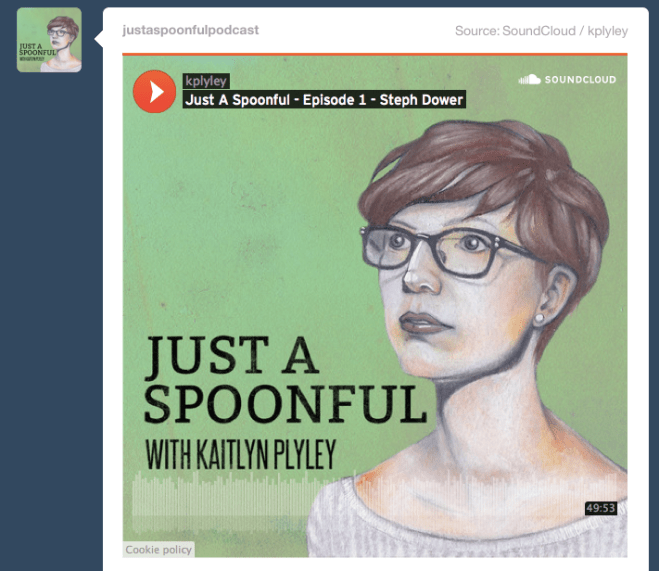
Episode 1 of Just A Spoonful is online and ready for listens! I’m still working out the whole iTunes thing but you can listen to the SoundCloud file via the Just A Spoonful site: justaspoonfulpodcast.tumblr.com

My guest for the first episode is filmmaker, TV producer and general sasspot Steph Dower. Steph is an intern at The Edge (State Library of Queensland), producer of Her Untold Story on 31 Digital, and works as a film editor. She lives with a permanent disability, and does not think Mark Wahlberg is funny. We talk movies, Michael Bay, and ‘living’ on the Disability Support Pension.

Here’s a photo of Steph at work (centre):

Borrowed from the Her Untold Story Facebook page: fb.com/heruntoldstory31

Her Untold Story: fb.com/heruntoldstory31

I’m pretty excited about this new project! I hope it will bring some entertainment to everyone, plus comfort to those living with chronic medical conditions and feeling like they’re “missing out” on youth. Take heart. We are young and fully sick.

Screen Shot 2014-09-24 at 11.29.37 PM